.png)



What Does ATS Stand For?
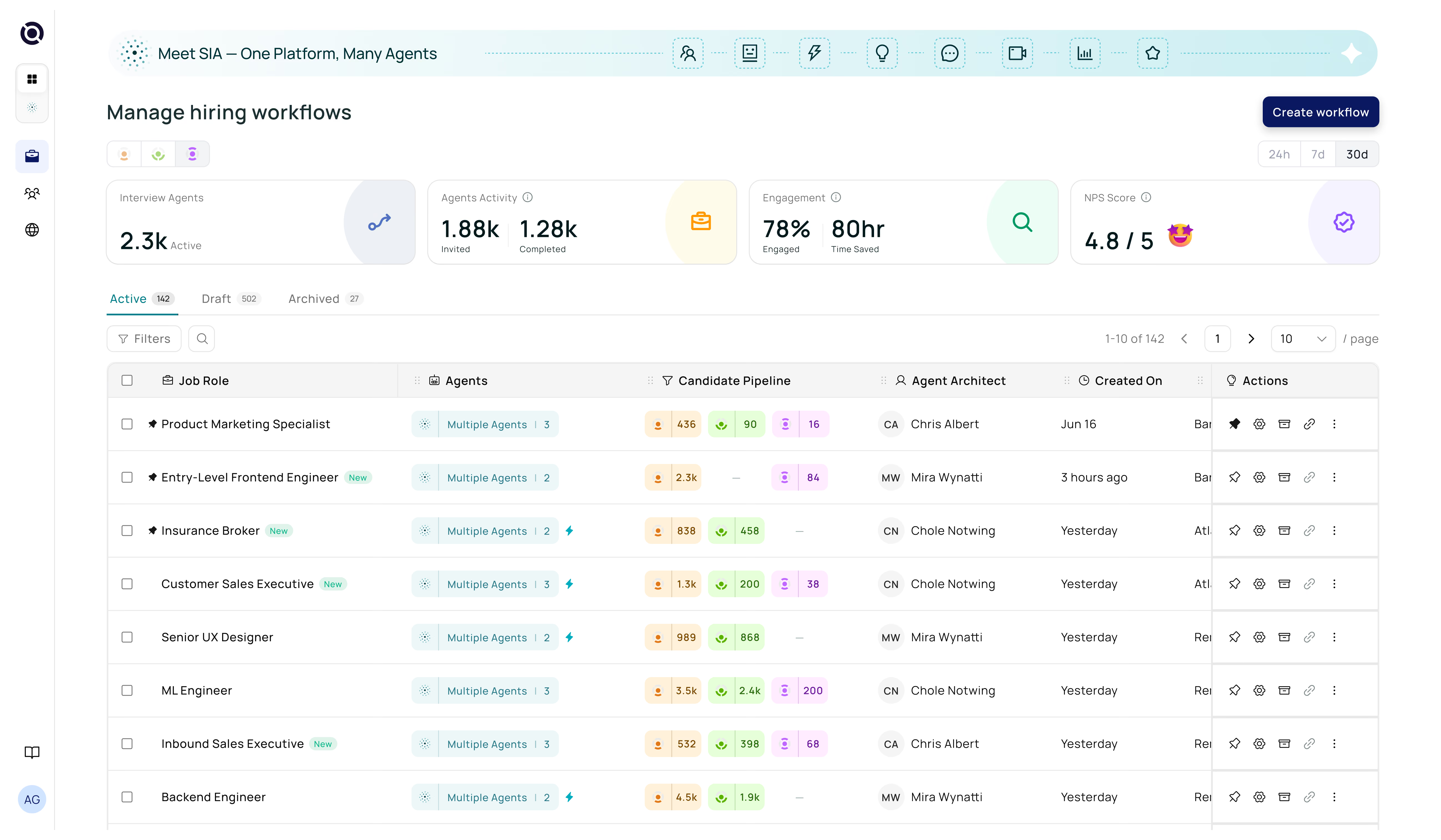
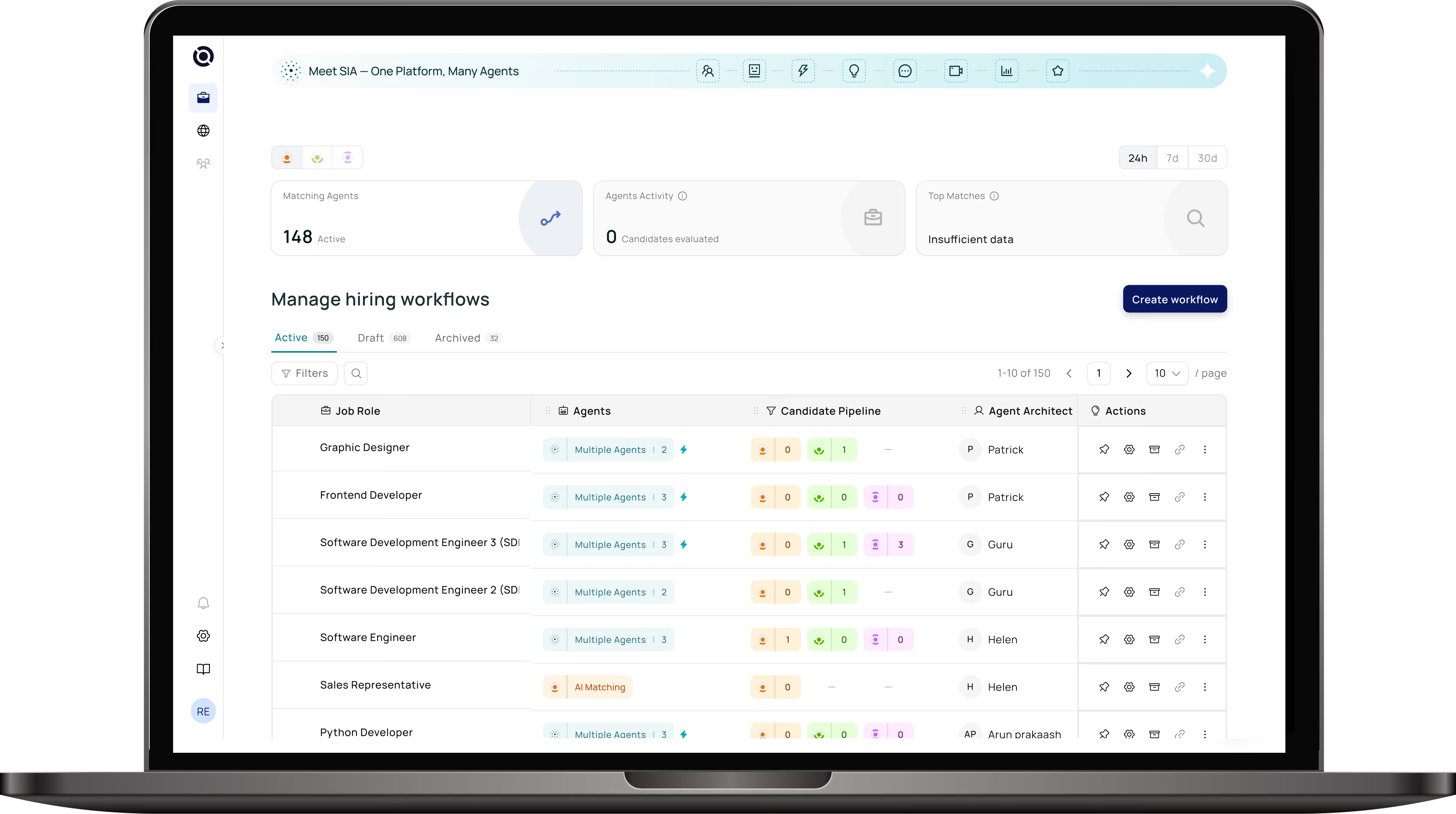
ATS stands for Applicant Tracking System — software that automates receiving, sorting, and managing job applications. It acts as the central command centre for a company's entire hiring workflow. Understanding what ATS stands for is the foundation for every recruiting professional.
The ATS Full Form in Context
When someone says "ATS" in HR or recruiting, they always mean Applicant Tracking System. The ATS acronym originated in the 1990s when large corporations needed structured ways to handle thousands of paper resumes. Today, it has evolved into a sophisticated platform covering job posting, resume parsing, candidate ranking, interview scheduling, and offer management.
To understand the full picture of what ATS means in HR, read our companion article: What Does ATS Mean in HR?
Modern ATS platforms like Senseloaf go beyond basic tracking — using AI to understand candidate fit, not just keyword matches. The future isn't just "tracking," it's intelligent shortlisting.
Why the ATS Acronym Matters for Recruiters
Understanding what ATS stands for is step one. Understanding what it does is where most hiring teams fall short. An applicant tracking system is not just a database of resumes — it is a living workflow engine that moves candidates through defined stages, flags best-fit applicants, and keeps every stakeholder aligned.
Curious about the mechanics? See How Does an ATS Work? for a step-by-step breakdown.
What does ATS stand for in the context of HR?
✓ Correct! ATS = Applicant Tracking System — the hub of modern recruiting.
ATS vs. Related Acronyms
The ATS acronym is often confused with related terms. For a complete glossary of HR tech abbreviations — including CRM, HRIS, HCM, TTF, and RPO — see our ATS Full Form & Abbreviation Guide.
What Does ATS Mean in HR?
In HR, ATS means Applicant Tracking System — the software layer that sits between a company's job postings and its workforce. It's where candidates enter, get evaluated, and emerge as new hires. But what ATS means in HR goes deeper than the technology itself.
Not sure what the acronym stands for? Start with What Does ATS Stand For? first.
In HR terms, an applicant tracking system is the operational core of talent acquisition: it digitises, standardises, and accelerates the full hiring lifecycle — from posting a role to signing an offer letter.
The HR Meaning Behind the ATS Acronym
HR professionals use ATS to describe both the software and the philosophy it represents: moving from intuition-driven hiring to data-driven decisions. When an HR manager says "we're running this through the ATS," they mean the role is live, applications are flowing in, and the system is helping rank candidates based on defined criteria.
To understand what happens inside that process, see How Does an ATS Work?
Job Requisition
HR creates and approves a job opening inside the ATS, triggering multi-channel posting.
Application Intake
Candidates apply via career pages, job boards, or referral links — all captured centrally.
Screening & Ranking
The applicant tracking system parses resumes, scores candidates, and surfaces the strongest matches.
Interview & Decision
Scheduled via the ATS, with feedback captured, hiring decisions logged, and compliance maintained.
ATS vs. Spreadsheets: The HR Reality
Many HR teams still track candidates in Excel. The meaning of ATS becomes clear when you compare the two: spreadsheets require manual updates, offer zero analytics, and break down at scale. A well-implemented applicant tracking system automates the tedious and surfaces the strategic.
Ready to evaluate one? See our ATS Requirements Checklist and our guide on ATS Implementation.
An ATS can only be used by large enterprises with 500+ employees.
✓ False! Modern ATS platforms including Senseloaf are designed to scale from startup to enterprise.
The Human Meaning of ATS in HR
Beyond software, ATS in HR represents a cultural shift: treating candidates as people in a journey, not tickets in a queue. The best applicant tracking system implementations improve the candidate experience — with faster responses, clearer communication, and less ghosting. That's what ATS truly means in modern HR: structured, humane, intelligent hiring.
For the full definition, see What Is ATS? A Definition for Hiring Teams.
How Does an ATS Work?
When a candidate clicks "Apply," a complex series of processes begins behind the scenes. Understanding how an ATS works gives both recruiters and candidates a significant advantage. If you're still unclear on what ATS stands for, start with our basics guide first.
Phase 1: Ingestion & Parsing — How Applicant Tracking Software Reads Resumes
The applicant tracking system first ingests the resume — whether PDF, Word, or plain text — and runs it through a parser. The parser extracts structured data: name, contact info, work history, education, and skills. This is where formatting matters most. For a deeper technical look, see How Does Applicant Tracking Software Work?
Two-column layouts, embedded images, and fancy headers are among the top reasons resumes get misread by ATS parsers. Simple formatting wins every time.
Phase 2: Keyword Matching & Scoring
Once parsed, the ATS system compares extracted data against the job description. Traditional platforms look for exact keyword matches — which is why a resume might say "managed" when the job description says "supervised" and get a lower score despite identical experience.
Modern AI-powered applicant tracking systems like Senseloaf use semantic understanding — recognising that "revenue growth" and "sales increase" mean the same thing. This is one of the key ATS requirements to look for when evaluating vendors.
What does a traditional ATS use to rank resumes?
✓ Exactly. Traditional ATS systems rely on keyword frequency and exact-match logic.
Phase 3: Stage Management
Approved candidates move through pipeline stages: Applied → Screening → Interview → Offer → Hired. Each stage triggers automated actions — emails to candidates, calendar invites, reminders to hiring managers. This is the "tracking" in Applicant Tracking System. The ATS integrations with your calendar and email tools make this seamless.
Phase 4: Collaboration & Decision
The ATS becomes a shared workspace where recruiters, hiring managers, and interviewers leave structured feedback, score candidates, and reach consensus. All of this is logged for compliance and future reporting. This is a critical part of any ATS implementation.
- Resume is received and stored in the ATS database
- Parser extracts work history, skills, and education
- Keywords are matched against the job description
- Candidate receives an automated acknowledgement email
- Application is ranked and surfaced (or not) to recruiters
ATS Acronyms & Abbreviations
ATS full form: Applicant Tracking System. But the HR tech world is full of related acronyms. This is your no-fluff guide to all of them. Already know the basics? Jump to What Is ATS? A Full Definition or learn how an ATS works.
| Acronym | Full Form | Used For |
|---|---|---|
| ATS | Applicant Tracking System | End-to-end recruiting workflow |
| CRM | Candidate Relationship Management | Nurturing passive candidates |
| HRIS | Human Resource Information System | Employee data management |
| HCM | Human Capital Management | Broader HR suite (includes ATS + HRIS) |
| JD | Job Description | Role definition for sourcing |
| SLA | Service Level Agreement | Hiring timeline commitments |
| TTF | Time-to-Fill | Days from opening to offer |
| TTH | Time-to-Hire | Days from application to offer |
| RPO | Recruitment Process Outsourcing | External hiring partner |
| DEI | Diversity, Equity & Inclusion | Equitable hiring practices |
ATS vs. Related Terms: What's the Difference?
The ATS abbreviation is often used interchangeably with broader terms. Understanding the distinctions is critical. For a full deep-dive, read ATS and CRM: What's the Difference? and ATS and CRM Software: Using Both Together.
ATS manages active applicants who have already applied. CRM manages your talent community — passive candidates, silver medalists, and future pipeline. The two work best together: CRM feeds talent into your ATS when roles open. Read the full comparison →
ATS is pre-hire. HRIS is post-hire. Once a candidate is hired via the ATS, their data flows into the HRIS for payroll, benefits, and performance management. See how ATS integrations work →
HCM encompasses everything from recruiting (ATS) to employee management (HRIS) to learning, payroll, and workforce planning. An applicant tracking system is a module within a full HCM suite, or a standalone best-of-breed tool.
When evaluating HR software, always clarify which abbreviations are truly supported. An HCM that "includes ATS" may have a basic module — not a dedicated, feature-rich applicant tracking system. Use our ATS requirements checklist to evaluate properly.
What does TTF stand for in recruiting metrics?
✓ Time-to-Fill! One of the most important metrics tracked inside an ATS.