.png)



Introduction
Talent acquisition used to be a linear, manual process: post a job, collect resumes, screen by hand, interview, hire. Every stage depended on recruiter bandwidth. The more roles you had, the more recruiters you needed.
AI in talent acquisition breaks that dependency. Not by replacing recruiters — but by removing the parts of the job that don't require human judgment, so the people doing the hiring can spend their time on the parts that do.
This guide walks through every stage of the talent acquisition funnel and shows exactly how AI transforms it. If you want a broader introduction first, read what AI in recruiting means and how it works. For a deeper look at the tools available, see our AI recruiting tools guide.
What "AI in Talent Acquisition" Actually Means
AI in talent acquisition refers to the use of machine learning, natural language processing, and agentic AI systems across the hiring lifecycle — from identifying potential candidates through sourcing, to evaluating them through screening and interviews, to learning from post-hire outcomes to improve future decisions.
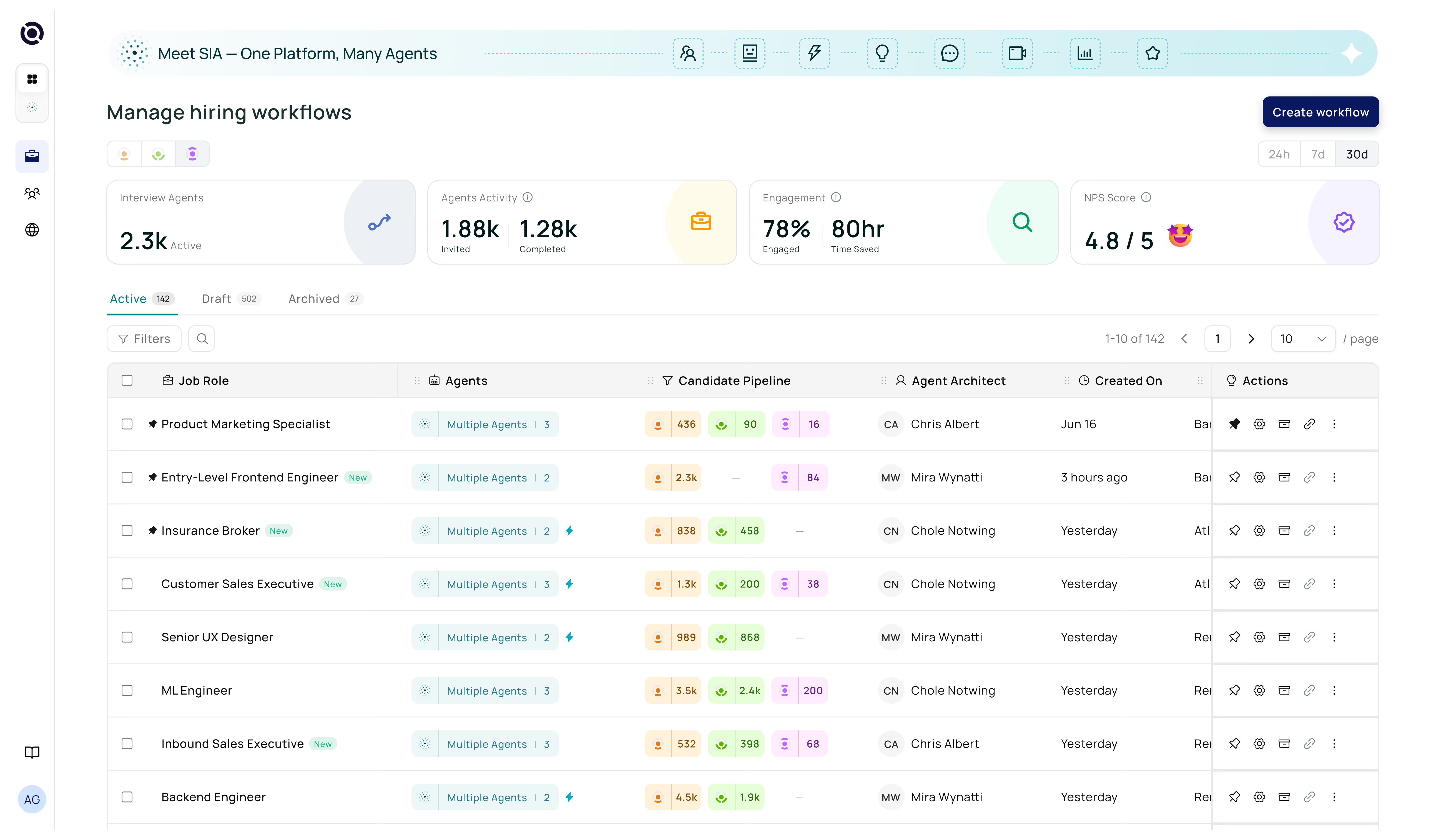
The key distinction: AI for talent acquisition is not a chatbot bolted onto your careers page. Done well, it's a set of intelligent agents that each own a specific part of the pipeline — and hand off to each other (and to humans) at the right moments.
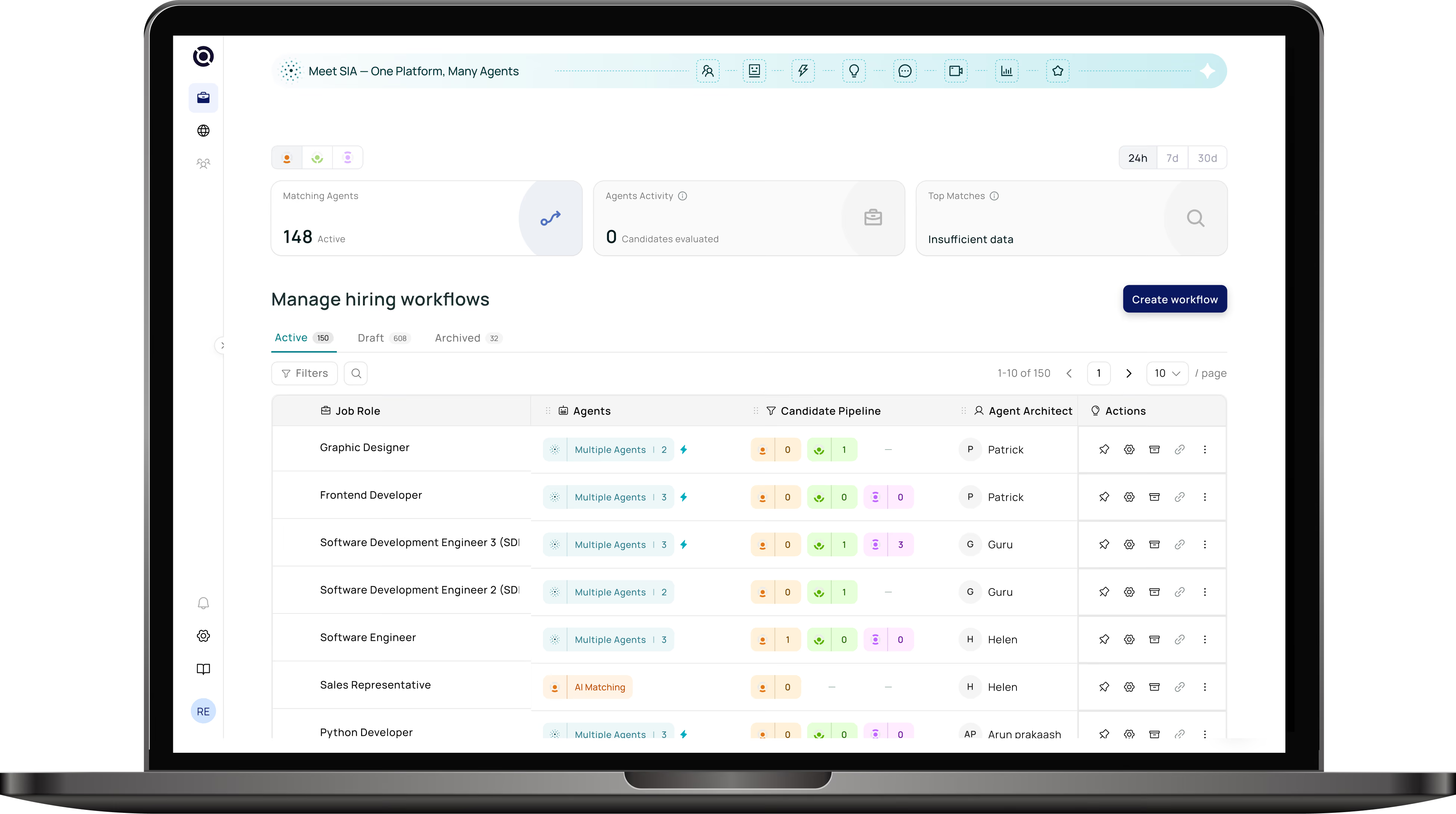
Think of AI in talent acquisition as a team of specialists rather than one generalist system. One agent sources. One ranks. One prescreens. One interviews. Each does its job better than a human could at scale — and each hands off to a human when judgment is what's needed.
AI Across Every Stage of Talent Acquisition
AI Candidate Sourcing
AI candidate sourcing identifies qualified people who haven't applied — from job boards, LinkedIn, GitHub, internal databases, alumni networks, and more. Rather than keyword-searching a database and hoping, AI sourcing tools learn from your past hires to identify the signals that predict success in specific roles. Senseloaf's AI Candidate Matching Agent does this by matching open roles against candidate profiles in real time — surfacing best-fit candidates in seconds, not days of manual sourcing.
Application Screening & Ranking
Every inbound application is automatically parsed, evaluated against the job requirements, and ranked. Recruiters open their queue and see a shortlist — not a pile. This is AI candidate screening in practice: instead of 20 hours reviewing 250 applications manually, a recruiter reviews the top 15 in 30 minutes with AI-generated rationale for each ranking.
Automated Prescreening & Candidate Engagement
Shortlisted candidates are automatically engaged with a structured prescreen — via conversational AI, voice agent, or asynchronous video. They answer role-specific questions at their convenience. The recruiter receives completed prescreen summaries, not a calendar full of 15-minute calls. AI voice agents are especially powerful here — how AI voice agents are transforming recruitment processes covers exactly this shift. Senseloaf's AI Prescreening Agent prescreening agent handles this stage end-to-end.
AI-Powered Structured Interviews
For roles requiring deeper evaluation, AI interview tools deliver structured, adaptive questioning — reducing interviewer inconsistency and capturing richer signal than an unstructured conversation. Senseloaf's AI Interviewer Agent AI interviewer runs structured interviews that probe competencies, evaluate responses, and produce a consistent hiring signal across every candidate — without the subjectivity of panel calibration.
Decision Support & Post-Hire Learning
AI in talent acquisition doesn't stop at the offer. Post-hire analytics close the loop: which sources produced the best 90-day performers? Where did strong candidates drop out? Which screening criteria predicted success — and which didn't? This feedback improves every upstream stage, compounding the value of AI over time.
What AI Does vs. What Stays Human
The most important question in any AI talent acquisition implementation: what decisions does the AI own, and where does human judgment remain essential? Here's how the best teams draw that line:
- Sourcing and profile matching at scale
- Resume parsing and initial ranking
- Automated prescreen conversations
- Scheduling and candidate communications
- Structured interview delivery and scoring
- Pipeline analytics and reporting
- Final hiring decision and offer
- Cultural and team fit assessment
- Senior and executive role evaluation
- Complex negotiation and candidate mgmt.
- Criteria configuration and model oversight
- Edge cases and exceptions
AI in Recruiting Automation: Where the Biggest Gains Come From
AI in recruiting automation delivers compounding returns — each automated stage creates capacity for the next. But the gains aren't evenly distributed. Here's where teams report the biggest impact:
| Automation Stage | Average Time Saved | Biggest Beneficiary |
|---|---|---|
| Resume screening | 15–20 hrs per role | High-volume recruiters |
| Candidate prescreening | 8–12 hrs per role | Agency and in-house teams |
| Interview scheduling | 3–5 hrs per role | Coordinator-heavy teams |
| Candidate status communications | 2–4 hrs per role | All teams |
| Pipeline reporting | 4–6 hrs per week | TA leaders and HRBPs |
Common Pitfalls in AI Talent Acquisition
Implementing AI Before Defining Success
What does a successful hire look like at 90 days? If your team can't answer that clearly, AI screening criteria will be misconfigured from day one. Define success metrics before you configure any AI tool.
Automating Candidate Communications Without Personalisation
Automated doesn't have to mean robotic. The best AI talent acquisition tools send communications that feel personalised — referencing the specific role, the candidate's background, and the next step clearly. Candidates don't care if a machine sent the message. They care if it felt like it was written for someone else.
Skipping the Integration Layer
AI talent acquisition tools that don't connect to your ATS create manual work at every handoff. Before selecting any tool, map out your integration requirements — your ATS, HRIS, calendar, and background check provider. See Senseloaf's integration ecosystem for how a fully connected TA stack looks in practice.
Not Revisiting AI Decisions with Human Oversight
The value of AI agents in talent acquisition compounds when recruiters regularly audit the AI's decisions. When a candidate ranked low goes on to perform well, that signal should update the model. Build oversight into your workflow from day one — not as a safety net, but as a growth engine.
The EU AI Act (effective August 2025) and NYC Local Law 144 both impose requirements on automated employment decision tools — including annual bias audits and candidate notification. Before deploying AI for talent acquisition at scale, confirm your vendor provides compliance documentation, audit trails, and supports bias testing. This isn't optional. It's table stakes.
Building Your AI Talent Acquisition Stack
The teams seeing the best results from AI in talent acquisition follow a deliberate sequencing:
- Start with screening. It's the highest-volume, lowest-judgment task — and the fastest to show ROI. See how AI candidate screening works.
- Add prescreening. Once your shortlists are AI-generated, automating the first conversation compounds the time saving dramatically.
- Layer in sourcing. Once your screening is calibrated, use AI sourcing to feed the top of the funnel with already-ranked candidates.
- Introduce structured AI interviews for volume roles where prescreen alone isn't enough signal.
- Close the loop with analytics. Use post-hire performance data to continuously improve the criteria driving stages 1–4.
For a platform built to run all five stages from day one, see how Senseloaf's agentic AI platform orchestrates the full pipeline. For a broader comparison of what's available, our AI recruiting tools guide covers every category. And if you're choosing between a modern AI platform and your current ATS, AI recruiting platforms vs traditional ATS maps the decision clearly.
The Bottom Line
AI in talent acquisition is not a feature you add to your hiring process. It's a new operating model for how hiring gets done — one that separates the high-volume mechanical work from the high-judgment human work, and assigns each to the right agent.
Teams that implement it well don't hire faster by cutting corners. They hire faster because every stage of the process runs without waiting for bandwidth. The quality of hire improves because the humans making decisions are better informed and less fatigued. And the candidate experience improves because no one gets ghosted when the process runs automatically.
That's what AI for talent acquisition actually delivers when it's done right. For the full picture, read the complete AI recruitment guide.