.png)



Introduction
Traditional automation waits for instructions. Agentic AI thinks, acts, and adapts—and it is already reshaping how organisations source, screen, and hire talent. Here is what that actually means for recruiters.
A further 82% of HR leaders plan to deploy agentic AI within their functions by mid-2026 (Gartner).
What Agentic AI Actually Means—and How It Differs from Automation
Most hiring teams are already familiar with automation—programming a system to execute specific tasks: send a follow-up email when a candidate reaches a certain stage, shortlist resumes containing certain keywords, trigger an interview slot after a form is submitted. The machine waits for a condition to be met, then acts.
Agentic AI for recruiting operates on an entirely different architecture. Rather than waiting for instructions, agentic systems analyse goals, assess current conditions, and determine the best next action in real time—without a human needing to specify every step.
The conceptual shift is significant. Traditional automation responds to triggers. Agentic AI in recruitment pursues objectives—and adjusts its approach based on what it encounters along the way.
| Traditional Automation | Agentic AI in Recruitment |
|---|---|
| Executes fixed, pre-programmed rules | Pursues defined goals through adaptive decision-making |
| Waits for human instruction at each step | Acts on its own judgment within governance boundaries |
| Breaks when conditions fall outside defined parameters | Adjusts strategy when pipelines stall or conditions shift |
| Cannot prioritise or re-sequence without reprogramming | Prioritises candidates dynamically as new signals emerge |
| Handles tasks in isolation—no continuity across stages | Connects screening, engagement, and assessment continuously |
| Requires manual handoff between recruitment phases | Hands off between stages without recruiter intervention |
In practical terms, AI agents in recruitment can prioritise the most promising candidates without being asked, nudge hiring managers or candidates when a process stalls, recommend alternative sourcing channels if a pipeline dries up, and flag emerging bottlenecks before they affect time-to-hire. This is not about replacing recruiters—it is about adding an AI-powered co-pilot operating a few steps ahead of the problem.
Traditional automation asks: “What instruction did I receive?” Agentic AI asks: “What is the goal, and what is the best next action to move toward it?” That single distinction changes everything about what becomes possible in high-volume, time-critical hiring.
Why Agentic AI Is Different in a Recruitment Context
Recruitment is not a linear process. Candidates drop off unexpectedly. Hiring managers change requirements mid-search. Pipelines run dry for specific skills. Assessment results shift how a candidate should be ranked. The process is dynamic—and traditional automation was never built for dynamic environments.
AI recruiting agents are built precisely for this reality. They can recalibrate candidate rankings when new assessment data comes in, re-engage candidates who went quiet at the pre-screening stage, and flag when a pipeline is underperforming against historical benchmarks—before a recruiter notices the problem in the weekly review.
Gartner’s research makes the scale of this shift explicit: 82% of HR leaders plan to deploy agentic AI for recruiting within their functions by mid-2026. The adoption curve mirrors what happened with ATS systems in the early 2000s—a capability that starts as a differentiator and becomes a baseline requirement within a few years.
Agency means the capacity to act on one’s own initiative. An agentic hiring system does not need to be told a candidate has gone quiet—it detects the signal and acts. It does not need to be told a pipeline is underperforming—it identifies the pattern and surfaces it. The value of agentic AI in recruitment compounds with every data point it processes—because it learns what good looks like, and pursues it autonomously.
By 2028, 33% of enterprise applications will integrate agentic AI—up from less than 1% today—and the AI recruitment industry is projected to reach $890.51 million.
Five Measurable Benefits of Agentic AI for Recruiting Teams
The case for agentic AI recruiting is not theoretical—the productivity and quality data is consistent across multiple research sources. Here are the five areas where the evidence is strongest.
Time Savings That Compound
Reduction in time spent on candidate identification. AI-driven sourcing, combined with AI pre-screening agents, cuts time-to-hire by up to 50%—and shrinks manual resume review by 70%.
Recruiters Become More Powerful, Not Less
Boost in overall recruiter productivity. 85% of recruiters say automation has already freed time to build stronger candidate relationships. Administrative burden cut by up to 40%.
Hiring Cost Reduction and Better ROI
More roles fulfilled internally when AI supports talent mobility decisions—cutting external hiring costs. Faster time-to-fill reduces opportunity costs; better matches reduce early churn and retraining.
Candidate Experience That Converts
Higher candidate satisfaction rates where AI recruitment agents support the process. Real-time communication, personalised updates, and smart scheduling keep candidates engaged through to offer.
Real-Time Recruiting, 24/7
Reduction in administrative burden. AI agents for recruitment orchestrate rescheduling, feedback chasing, ATS updates, and candidate progression automatically—keeping the process moving when humans are unavailable.
Only 31% of candidates are comfortable with AI making the hiring decision independently. That figure rises to 75% when a human is demonstrably involved in the final decision. This data point defines the correct deployment model for agentic AI in recruitment: autonomous on volume-intensive, low-complexity tasks—with human oversight preserved at consequential decision points.
The best recruiters will always be defined by their ability to understand people—their motivations, hesitations, and potential. Agentic AI for recruiting does not take that away. It removes the noise, the tedium, and the bottlenecks—so recruiters can show up fully at the moments that actually determine whether a candidate accepts an offer or moves on.
“The future of recruitment is not about choosing between human and machine. It is about humans working with agentic AI—smarter, faster, and more strategically than either could manage alone.”— Senseloaf AI, Brand Principles, 2026
Meet SIA: Senseloaf’s Intelligent Agent Ecosystem
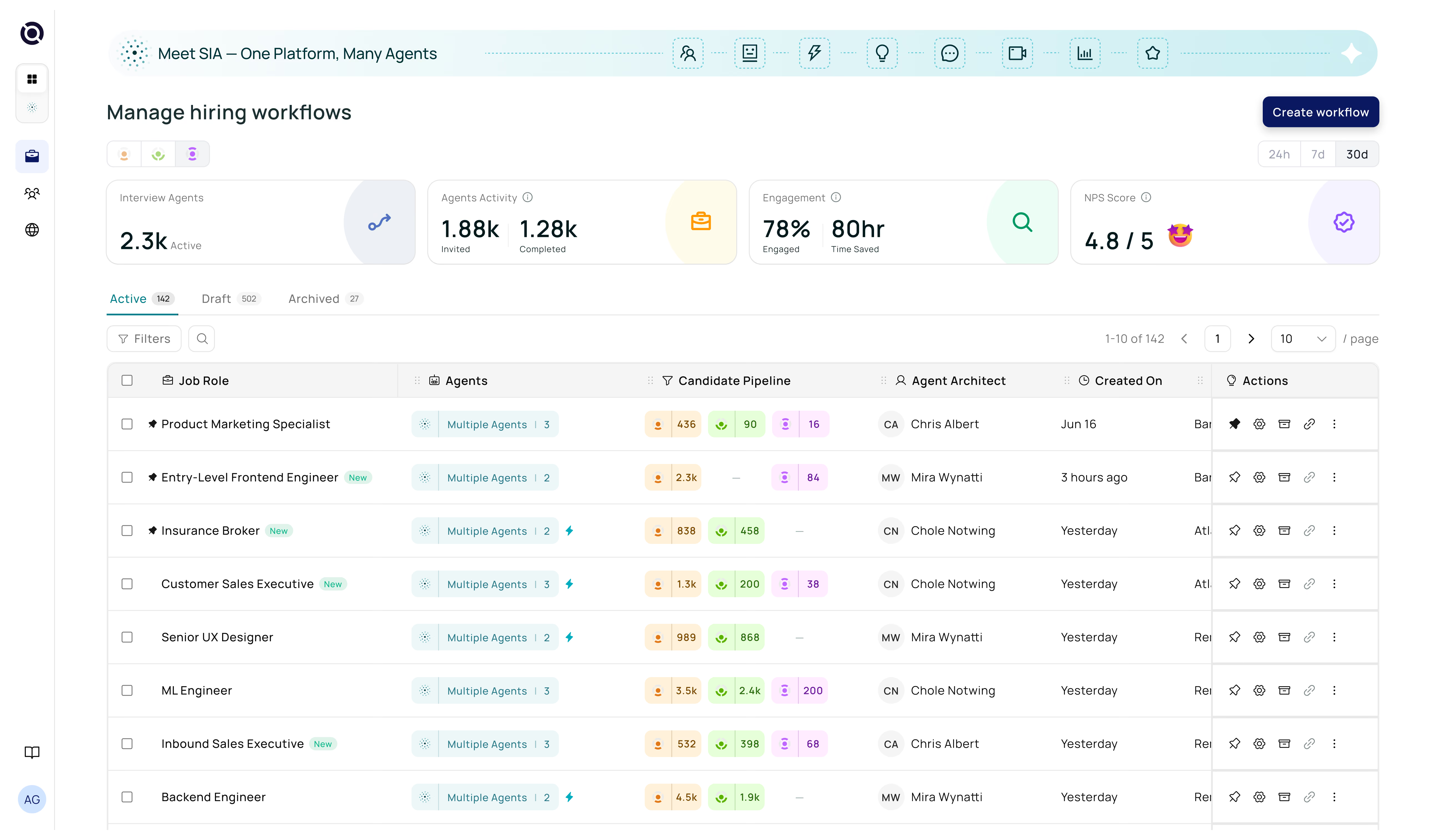
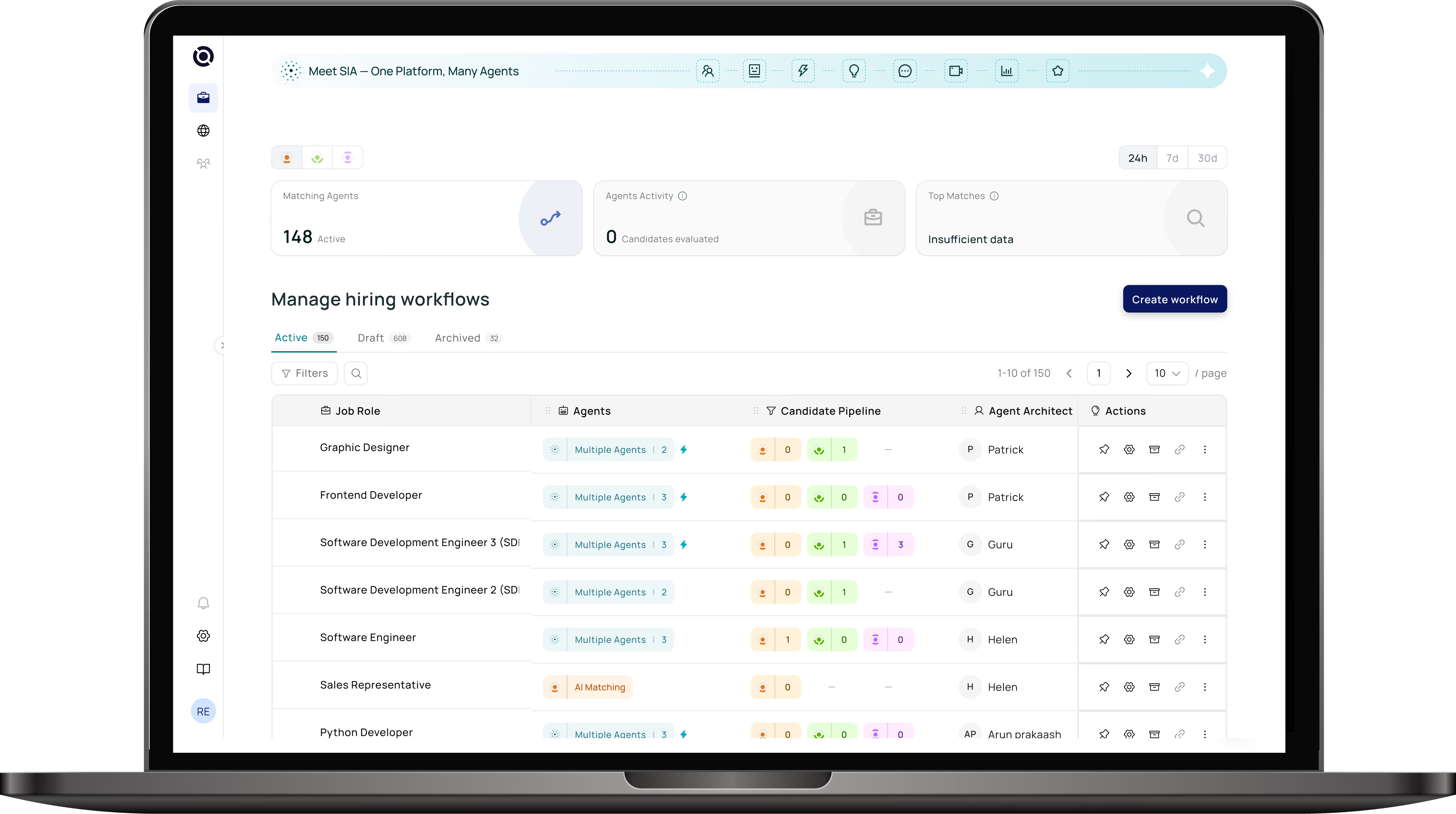
Senseloaf’s approach to AI agents for recruiting is built on three specialised agents—each governing a distinct phase of the candidate qualification pipeline, each operating within clear governance boundaries, and all working together as a unified intelligent system that connects directly to the recruiter’s existing ATS.
SIA—Senseloaf Intelligent Agent—is not a single monolithic tool. It is an ecosystem of purpose-built agents, each designed to be the top AI recruiter agent for its specific stage of the process.
Resume Matching Agent
Evaluates and ranks every incoming application against job-relevant criteria—skills, experience, seniority, role alignment—in real time, inside the ATS. No recruiter action is required at this stage; every score is explainable, traceable, and defensible.
AI Pre-Screening Agent
Engages qualified candidates instantly via conversational AI for hiring—answering questions, collecting qualification information, and routing candidates to assessments without recruiter involvement. Available 24/7, delivering consistent candidate experience at any volume.
AI Interview Agent
Conducts structured, skills-focused AI interviews with proctoring signals—maintaining evaluation consistency across every candidate regardless of business unit, role type, or hiring volume. Every output is logged and reviewable.
The three agents operate as a continuous qualification pipeline—each one feeding its outputs into the next, and all results syncing back into the recruiter’s ATS as the system of record. This is what distinguishes Senseloaf’s AI recruiting agents from standalone point tools: not just automation at individual stages, but intelligent orchestration across the entire hiring funnel.
Every SIA agent operates within defined governance boundaries—protecting candidates from discriminatory evaluation criteria, maintaining full audit trails of every decision, and keeping human recruiters accountable for final outcomes. Agentic AI in recruitment without governance is not a faster hiring process—it is a compliance liability operating at scale.
The Agentic AI Wave: What Is Coming and Why It Matters Now
If agentic AI for recruiting still feels like an emerging technology, the timeline for mass adoption is shorter than most organisations expect. The data on where enterprise AI is heading makes the urgency clear.
Early Majority Adoption
82% of HR leaders plan to deploy agentic AI recruiting capabilities within their teams by mid-2026. Organisations deploying now are establishing the data history and governance frameworks that will define competitive advantage in the next hiring cycle.
AI Proficiency Becomes a Hiring Standard
Gartner projects that by 2027, 75% of hiring processes will include certifications or assessments for workplace AI proficiency. The recruiter’s ability to work effectively with AI agents in recruitment becomes a core job competency—not a nice-to-have.
Agentic AI Becomes the Enterprise Default
33% of enterprise applications will integrate agentic AI by 2028—up from less than 1% today. The AI recruitment industry is projected to reach $890.51 million. Half of all businesses using generative AI are expected to run active agentic AI recruitment pilots by 2027. For organisations that start now, the infrastructure will already be mature by the time it becomes a baseline requirement.
The companies getting ahead of this curve will not simply be faster. They will be more strategic, more data-driven, and more resilient—with hiring pipelines that improve continuously as their AI recruitment agents accumulate data on what excellent hiring looks like for their specific roles and markets.
Frequently Asked Questions
A live walkthrough of Senseloaf’s SIA agents—with data, governance architecture, and a deployment model built around your existing ATS. Book a free demo.