.png)



The New Pressure on HR Leaders
Hiring teams are being pushed to their limits — expected to fill roles faster, cut costs, elevate candidate experience, and still make the right hire every time. Most HR departments are still running on tools built for a different era: rule-based ATS platforms, manual screening queues, and disconnected workflows that drain recruiter hours daily.
According to PwC's 2025 Global AI Jobs Barometer, industries most exposed to AI are achieving 3x higher revenue growth per employee. The productivity dividend is real and growing. Yet in HR specifically, only 40% of companies have deployed AI agents — even as 79% of executives report using them elsewhere in their organisations.
While 79% of executives say AI agents are already adopted across their companies, only 40% are using them in HR — leaving a massive untapped advantage for early movers. (PwC AI Agent Survey)
This guide explains what agentic AI actually is, why it represents a fundamentally different category of HR tool, what the data says about its business impact, and how to move from pilot to full-scale transformation.
"85% of talent acquisition leaders say they are under pressure to hire faster without sacrificing quality. The answer is not working harder — it is working with smarter, autonomous AI HR software built for the complexity of modern hiring."
— LinkedIn Global Talent Trends ReportWhat Is Agentic AI — And Why Does It Change Everything?
From automation to autonomous intelligence
The term "HR AI" has been overused. For years, vendors labelled basic keyword filtering as "AI-powered HR solutions." Agentic AI is categorically different. Rather than following a fixed script, an AI agent observes its environment, forms a plan, and takes action in pursuit of a defined goal — retaining memory, collaborating with other agents, and adapting over time.
The Core Loop: Observe, Plan, Act
Observe
Continuously scans job postings, candidate profiles, application signals, and recruiter feedback — building a real-time picture of the hiring environment.
Plan
Uses large language models and stored context to determine the optimal next action: who to contact, which candidates to shortlist, when to escalate to a human.
Act
Executes — scheduling interviews, ranking CVs, sending personalised outreach, updating your ATS — then loops back to observe and refine.
What Makes AI Agents Unique in HR
Memory
Retains full context across every interaction — candidate conversations, recruiter preferences, historical outcomes. No repetition, no lost context.
Autonomy
Decides when and how to act without constant human input. The agent manages the workflow; your recruiter manages the relationship.
Adaptability
Responds to real-time changes in hiring needs and candidate availability — always calibrating, getting smarter with every interaction.
Goal-Driven Intelligence
Optimises for outcomes — quality of hire, time-to-fill, candidate satisfaction — not just task completion.
"The power of agents is that they don't just perform structured tasks. If you give them high-level goals, they can interact with their environment, with each other and with people to get the job done."
— PwC, Future of HR (2025)The Business Case: Hard Numbers Behind HR AI
Why the ROI on agentic AI in HR is no longer theoretical
The Productivity Premium Is Real
Source: PwC 2025 Global AI Jobs Barometer — analysis of close to one billion job ads
Since 2022, productivity growth in industries best positioned to adopt AI has nearly quadrupled. Companies in AI-exposed sectors moved from productivity laggards to leaders in under two years. This is not a projection — it is already happening.
Companies using AI only to cut headcount miss the bigger opportunity: new markets, new revenue streams, and more valuable employees. Wages and job numbers are growing in AI-exposed roles, not shrinking.
The HR-Specific Impact
| HR Function | Agent Capability | Human Effort Savings |
|---|---|---|
| Administrative (forms, reporting) | Over 88% agent-driven | Up to 88% |
| Functional / Day-to-Day Processes | Over 60% automated or assisted | 50–60% |
| Advisory (talent guidance) | ~50% agent-assisted | 40–50% |
| Strategy & Culture | Primarily human-led | Efficiency gains only |
Source: PwC Future of HR — 5 Actions CHROs Should Take Now (2025)
The Hiring-Specific Numbers
Sources: IBM AI in HR Research; PwC Future of HR (2025); HRTech Adoption Report 2024
The Hire-to-Retire Transformation
How agentic AI reshapes every stage of the employee lifecycle
Traditional HR AI software addresses individual pain points in isolation. Agentic AI creates an interconnected, continuously learning system that spans the entire hire-to-retire lifecycle — from the moment a requisition is raised to the day an employee exits.
Talent Acquisition: From Requisition to Shortlist
Requisition Agent
Drafts the job description, checks it against existing roles, aligns with job architecture, and sends for manager approval — automatically.
Sourcing & Screening Agent
Posts across internal and external boards, screens profiles on contextual fit (not keywords), and ranks shortlists with scoring rationale.
Engagement Agent
Reaches out to candidates, handles scheduling, sends personalised communications, and keeps candidates warm throughout the process.
Interview Preparation Agent
Curates interview guides, prepares structured scorecards, and briefs the hiring panel — ensuring consistency and reducing unconscious bias.
Recruiters shift from administrative coordination to high-value work: personalised candidate relationships, coaching internal talent, and strategic advisory to the business. (PwC Future of HR, 2025)
Talent Development & Internal Mobility
Skills Gap Analysis
Employees share aspirations with an agent that evaluates experience, identifies internal opportunities, and pinpoints gaps — creating a personalised learning plan in minutes.
Continuous Profile Updates
As employees complete training, agents automatically update profiles, recommend relevant roles, and notify recruiters of internal candidates.
Manager Coaching Focus
With agents handling routine talent management, managers spend more time on the human dimensions of leadership AI cannot replicate.
Proactive Succession Planning
Agents monitor talent pipelines continuously, flagging emerging leaders, identifying flight risks, and modelling succession scenarios as an always-on capability.
The Full Agentic HR Scope
- Benefits Administration: Agents handle enrolment, changes, and queries — reducing HR ticket volume significantly.
- Payroll Support: Automated validation, exception handling, and employee self-service queries.
- Performance Management: Continuous feedback collection and goal tracking — beyond the annual review cycle.
- Workforce Planning: Agents model headcount scenarios, analyse attrition risk, and surface capacity gaps proactively.
- Employee Relations: First-line handling of policy queries, escalation routing, and sentiment monitoring.
AI-Powered HR Solutions in Action
Meet the Senseloaf Intelligent Agent Suite
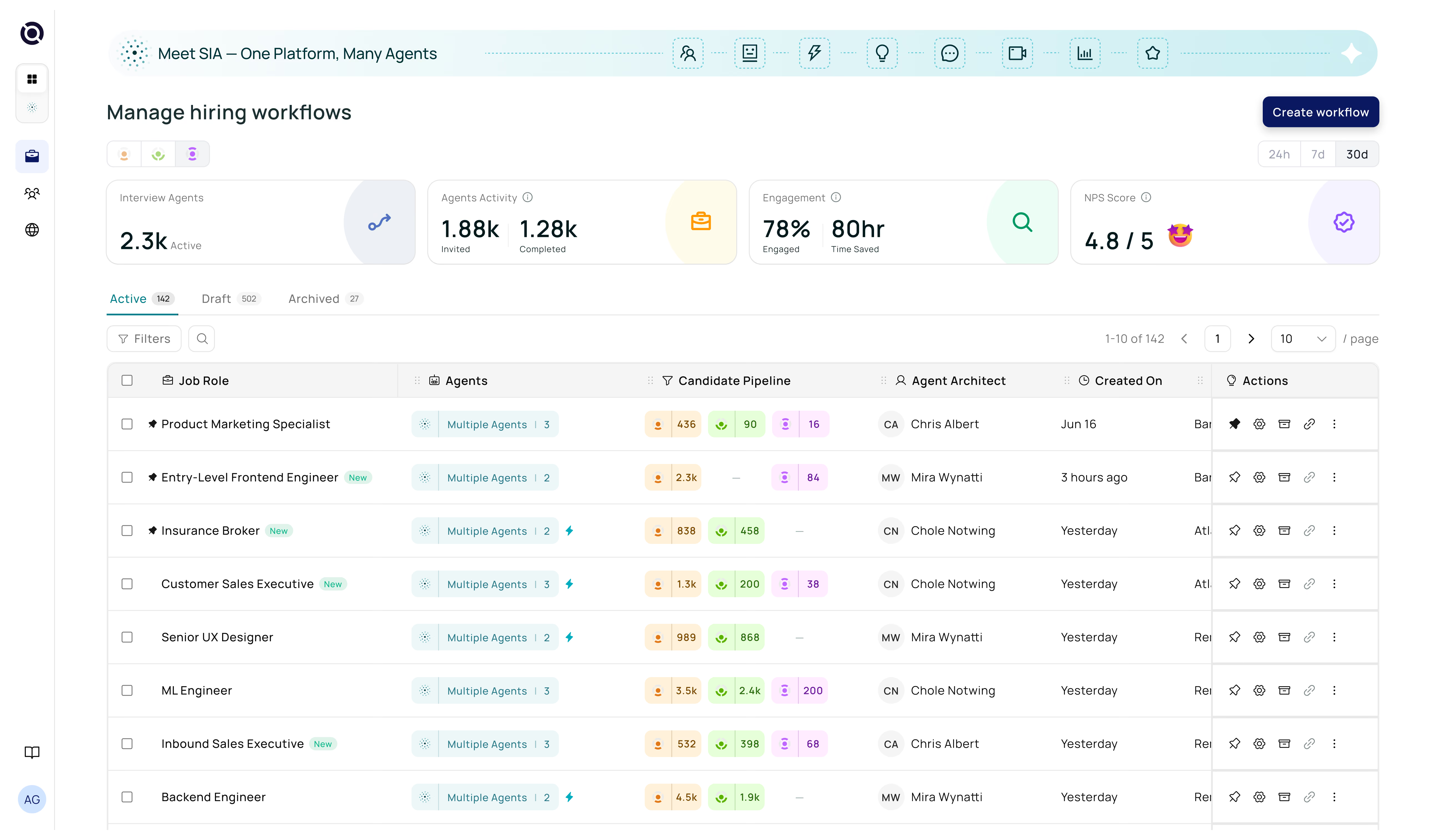
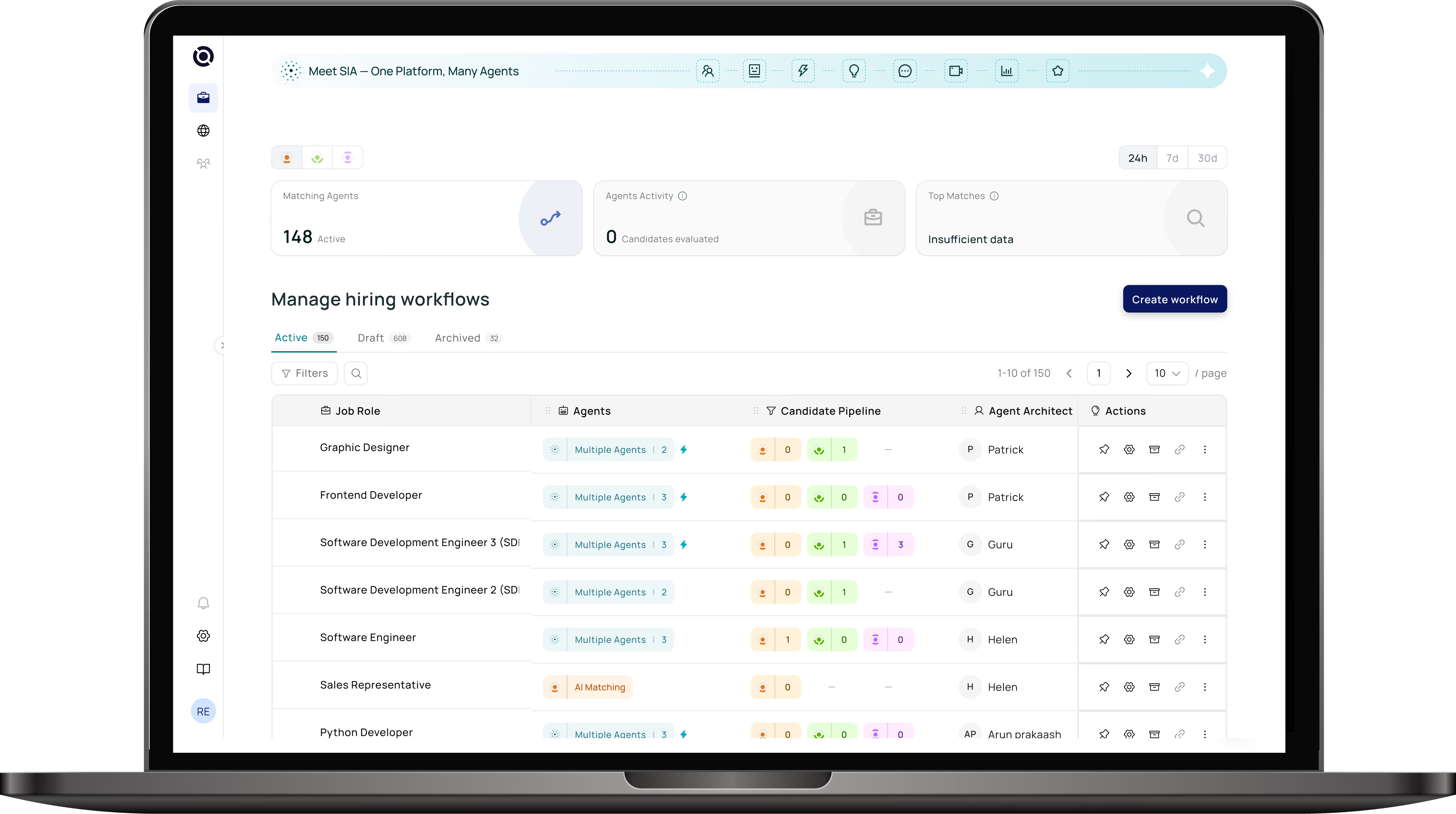
Senseloaf is purpose-built for the age of agentic AI in HR — an interconnected suite of autonomous agents, each expert in a specific hiring function, all capable of working together as an orchestrated recruiting team. The SIA Suite integrates directly with your existing ATS, HRIS, and job boards — no rip-and-replace required.
Evaluates thousands of profiles in seconds — assessing contextual skills fit, role history patterns, and career trajectory, not keyword overlap. Shortlists are ranked with scoring rationale, giving recruiters a defensible basis for every decision.
Explore →Conducts structured prescreening conversations with every applicant — at any hour, at any volume. Applies consistent evaluation criteria, monitors for adverse impact, and surfaces only the most relevant candidates.
Explore →Agent
Runs adaptive, structured AI-facilitated interviews with standardised scoring, candidate consent workflows, and human oversight at decision points. Hiring panels receive rich insights before speaking to a single candidate.
Explore →Four Promises of Agentic Hiring
Empower Me
Candidates are guided through the entire application journey with proactive updates and contextual support — always knowing where they stand.
Know Me
From the first interaction, the agent captures skills, preferences, and behaviours — offering roles and prep materials that feel genuinely relevant.
Reach Me
Perfect timing on every communication — nudges, role updates, next-step prompts — maximising engagement and minimising application drop-off.
Show Me
Tailored interview guides, culture insights, and personalised job matches. Candidates get the right opportunity, clearly communicated.
Senseloaf's agentic AI ensures every candidate receives a consistent, high-quality, brand-safe experience at scale. (CareerBuilder Candidate Behavior Study)
AI Tools for HR Management: What to Look For
Evaluating HR AI software beyond the marketing
The market for HR AI tools has expanded rapidly and quality varies enormously. Many solutions labelled "AI-powered HR tools" are built on simple automation logic. Distinguishing genuine agentic AI from enhanced automation is critical before committing.
Six Criteria for Evaluating AI HR Software
Goal-Directed, Not Just Task-Directed
True agentic AI pursues outcomes — a quality hire within a defined timeframe. Ask vendors: does the system optimise towards a defined goal, or just complete steps?
Memory and Context Retention
Agentic systems retain context across sessions, conversations, and time. If every session starts from scratch, it is not agentic.
Multi-Agent Orchestration
The most powerful HR AI systems deploy specialised agents that collaborate — sourcing → prescreening → interview → offer. Look for genuine agent coordination.
Human-in-the-Loop Design
Responsible artificial intelligence HR software has clear human oversight at decision points. Bias monitoring and adverse-impact tracking must be built in, not bolted on.
Deep ATS and HRIS Integration
The best human resources AI tools integrate deeply with your existing stack. Senseloaf integrates with SAP SuccessFactors, Greenhouse, Lever, BambooHR, and more — senseloaf.ai/integration.
Measurable ROI Within Weeks
Mature agentic AI HR companies demonstrate measurable impact within 30 days. If a vendor cannot show a clear ROI timeline with customer evidence, treat it as a red flag.
PwC's research shows employer-required skills are changing 66% faster in AI-exposed roles — more than 2.5x faster than just last year. The right AI for HR solutions tracks live skills trends and adapts hiring criteria continuously.
From Pilot to Scale: Implementing AI HR Software
5 actions for CHROs ready to move now
The most common mistake HR leaders make with AI implementation is waiting for perfect conditions. The organisations pulling ahead started with something specific, measured the impact, and scaled what worked.
Find Your Quick Wins First
Identify where agents can deliver value fast. High-volume, repetitive processes — candidate screening, interview scheduling, benefits queries — typically show ROI within 30 days.
Start Small, Design for Reuse
Deploy one or two agents in a defined workflow. Prove the value, build buy-in, but design the architecture for reuse from day one so scaling becomes progressively cheaper.
Show Your People Their New Value
Recruiters need to see that agentic AI tools make them more valuable — not redundant. PwC's data confirms: AI makes workers more productive and better compensated.
Build a Clear Governance Model
Define who is accountable for agent decisions, how errors are surfaced, and how bias is monitored. Trust is the most important determinant of whether AI's value is actually realised.
Reinvest the Freed Capacity Strategically
When your HR team has 40–50% of their day freed by agents, plan what they do with it. Shift capacity to employer branding, DEI, and strategic workforce planning.
"Only 6% of employees feel very comfortable using AI in their current role. CHROs who communicate a clear adoption strategy can increase AI comfort levels by nearly 5x. The plan you share matters as much as the technology you deploy."
— Gallup 2024 Workforce AI Readiness StudyThe Four Pillars of Successful AI HR Adoption
Clearly Communicated Strategy
Only 15% of employees report hearing a clear AI integration strategy from leadership. When communicated clearly, employees are nearly 5x more likely to feel comfortable using AI.
Established Usage Guidance
70% of employees say their workplace lacks formal AI use policies. Without clear guidance on acceptable use and escalation paths, adoption stalls and risk increases.
Role-Specific Training
Employees with formal, role-aligned training are nearly twice as likely to view AI as a productivity booster. Recruiter-specific agent training makes the critical difference.
Continuous Feedback Loops
Regular feedback from recruiters, hiring managers, and candidates improves agent accuracy over time — creating a compounding advantage that widens the gap with slower competitors.
The Future of HR AI: What's Next
From task automation to organisational intelligence
The agentic AI in HR revolution is not a destination — it is an acceleration. Understanding where the space is heading, and positioning your organisation to benefit early, is now a core CHRO competency.
Four Shifts That Will Define the Next Era
From Reactive to Predictive HR
The next generation will predict events: surfacing attrition risk before a resignation lands, modelling future skill gaps, identifying ideal candidate pools before a role is officially opened.
From Individual Agents to Agent Teams
Multi-agent orchestration — specialised agents collaborating and collectively pursuing complex goals — is emerging. Interconnected ecosystems will create structural advantages point-solution AI cannot match.
Skills Over Degrees
PwC data shows employer demand for formal degrees is declining fastest in AI-exposed roles. HR tools will increasingly evaluate demonstrated capability — opening talent pools to millions currently overlooked.
AI as a Workforce Multiplier
The dominant strategy will shift from "efficiency" to "growth" framing — using AI to expand what the HR function can accomplish, not just reduce what it costs.
Skills required in AI-exposed jobs are changing 66% faster than in other roles — more than 2.5x faster than just one year ago. HR teams deploying AI-based HR software that tracks live skills trends will have a decisive advantage in talent planning. (PwC 2025 Global AI Jobs Barometer)
Why Early Movers Win
Only 40% of companies are using AI agents in HR today — even as 79% use them elsewhere. The window for first-mover advantage is open now. Organisations that move first will accumulate proprietary data, refine agent accuracy, and build institutional knowledge that competitors cannot replicate simply by buying the same software later.
The Strategic Imperative: Start Now
For too long, HR has been positioned as a cost centre managing risk. AI agents shift that equation fundamentally. When the operational burden is handled — the screening, the scheduling, the administration — HR becomes a strategic function that shapes organisational capability and gives companies a durable competitive advantage in the talent market.
The data from PwC, McKinsey, IBM, and others is converging on the same conclusion: AI does not replace HR professionals. It makes them dramatically more valuable. Workers in AI-exposed industries are earning more, contributing more, and growing faster than their peers.
Organisations deploying agentic AI for HR automation are achieving 10x faster time-to-hire, 70% reductions in sourcing time, and 40% lower recruiter workload — right now, in production environments. This is not the future. It is this quarter.
Start small, prove fast, and scale with intent. One agent, one workflow, one measurable outcome. Then build from there.
Key Sources
- PwC 2025 Global AI Jobs Barometer — Analysis of close to a billion job ads across six continents
- PwC Future of HR: 5 Actions CHROs Should Take Now (September 2025)
- IBM AI in HR Research — AI-driven resume screening and time-to-hire benchmarks
- LinkedIn Global Talent Trends Report — Talent acquisition leader survey data
- Gallup 2024 Workforce AI Readiness Study — Employee AI comfort and adoption data
- McKinsey Global Survey on AI 2024 — AI maturity and talent outcomes
- Salesforce 2024 CHRO Survey — Agentic AI adoption projections
- HRTech Adoption Report 2024 — Recruiter automation and candidate satisfaction benchmarks
- CareerBuilder Candidate Behavior Study — Application abandonment and experience data
This guide was produced by Senseloaf.ai. All third-party statistics are attributed to their respective sources. Senseloaf.ai is not affiliated with any cited research organisations.