.png)



Introduction
JobDiva is designed for scale and speed. Recruiters manage large pipelines and tight timelines every day. And for teams running high-volume staffing operations, an AI-powered applicant tracking system integration isn't a nice-to-have — it's what determines whether that scale becomes an advantage or a bottleneck.
According to SHRM's 2025 research, 89% of HR professionals whose organisations use AI in recruiting say it saves them time or increases efficiency. And Gartner identifies high-volume, frontline roles as the ideal profile for an AI-first approach — the highest potential for cost savings, the best fit for AI's consistency strengths, and the environment where recruiter capacity is most frequently the constraint. That's a precise description of the staffing teams running on JobDiva every day.
The Scale Problem Every JobDiva Team Knows
If your recruiting team runs on JobDiva, chances are you are dealing with scale. Not just more candidates — more of everything. More resumes per role. More submittals per recruiter. More client feedback loops. More interview coordination. More pressure to move fast without sacrificing quality.
JobDiva is built for staffing, high-volume, and fast-moving recruitment environments. But even the most capable AI applicant tracking system starts to strain when recruiters are expected to manually screen hundreds of profiles, chase candidates for responses, and coordinate interviews across multiple clients simultaneously. The ATS organises the pipeline. It doesn't work it.
SHRM data shows that recruiting automation adopters fill 64% more jobs and submit 33% more candidates per recruiter compared to teams without it. The gap between those two groups isn't talent or effort — it's whether their tools are absorbing the volume or leaving it on the recruiter's desk.
The constraint in high-volume staffing is rarely sourcing. It's everything that happens between a candidate entering the pipeline and a recruiter being confident enough to submit them to a client. Manual screening, inconsistent prescreening, slow outreach, and disconnected coordination — these are the friction points that slow submittals and cost placements. This is exactly where AI hiring fits.
What AI Hiring with JobDiva Actually Means
AI hiring with JobDiva refers to AI-powered recruiting agents that integrate natively with JobDiva to automate repetitive hiring operations while keeping recruiters firmly in control of decisions and client relationships.
The distinction matters. There are standalone AI recruiting tools that require parallel workflows, separate logins, and manual data syncing back to the ATS. These tools create more work, not less. A true AI-powered applicant tracking system integration works inside JobDiva — evaluating candidates as they enter the pipeline, running structured prescreening at scale, coordinating interviews automatically, and syncing every insight directly into JobDiva candidate records without the recruiter needing to leave the system they already use.
No spreadsheets. No tool-hopping. No broken audit trails. Recruiters stay in the ATS — and stay in control.
Basic workflow automation in an ATS handles triggers and rules — send this email when a candidate reaches this stage. Agentic AI hiring goes further: it evaluates candidate responses, applies role-specific scoring logic, conducts structured prescreening conversations, and produces ranked shortlists that reflect actual candidate quality. The output isn't just a task completed — it's a decision supported. For a full breakdown of how to connect AI tools with your ATS effectively, see our guide on how to integrate AI recruiting tools with an applicant tracking system.
The AI Hiring Workflow Inside JobDiva
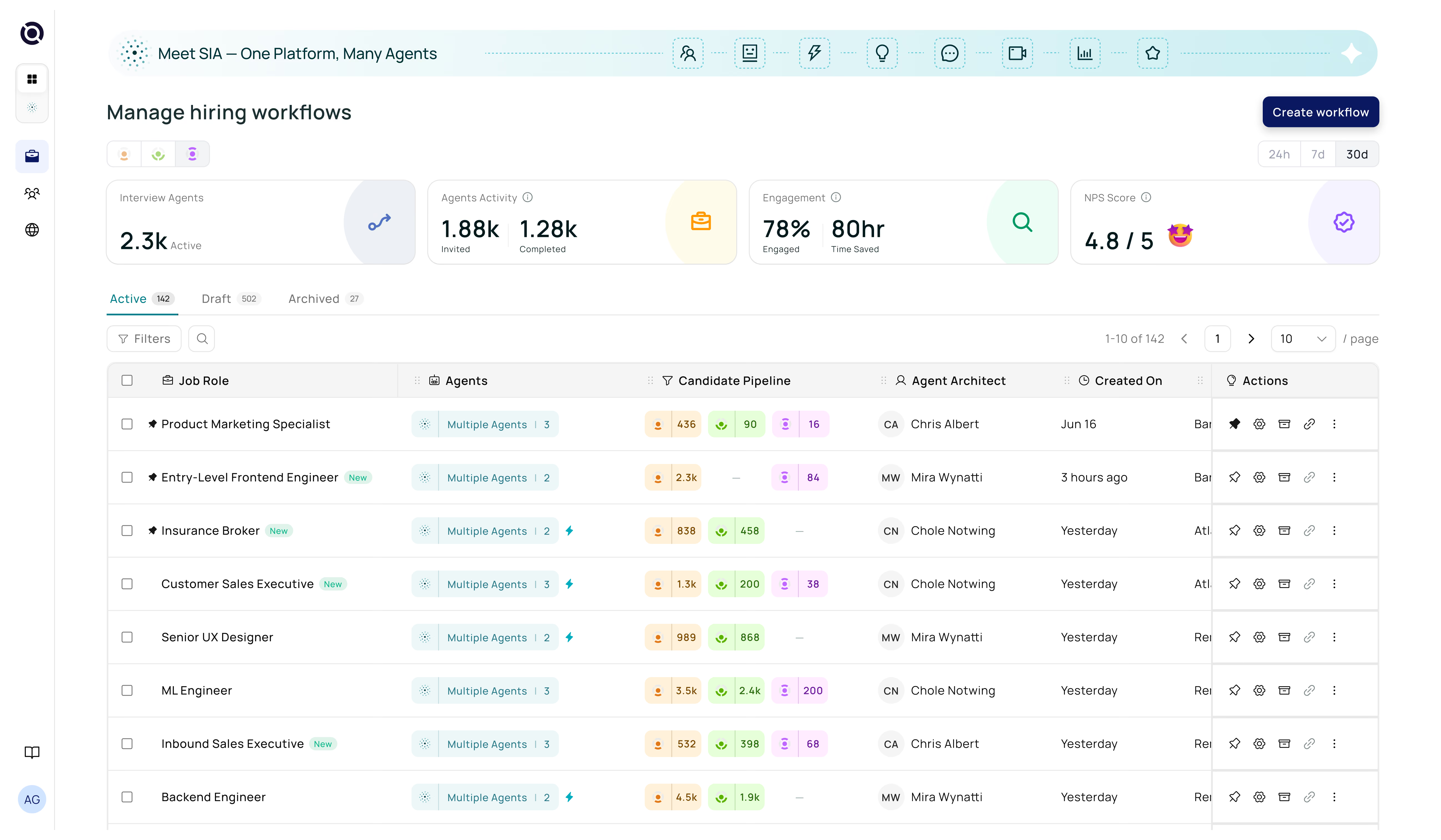
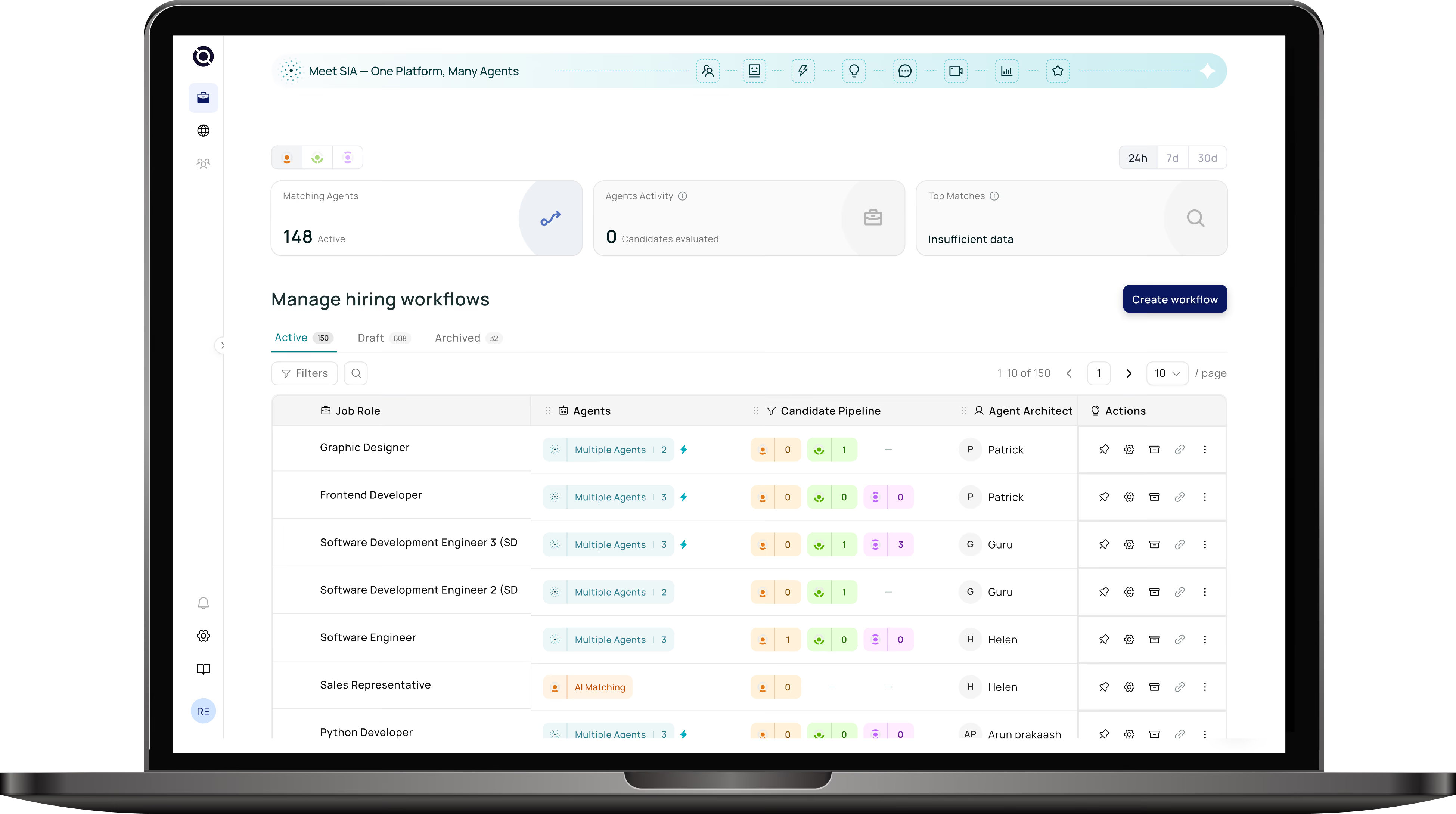
The integration is designed to absorb volume without creating chaos. Here is what the workflow looks like in practice — from job creation to shortlist delivery — entirely within JobDiva.
AI Resume Screening Integrated with JobDiva
Staffing teams cannot afford to manually read every resume at scale. AI screening agents evaluate candidates instantly as they enter the pipeline — matching resumes to role requirements, scoring profiles using structured and explainable logic, and highlighting both top-fit candidates and edge cases worth a closer look. Scores and explanations appear inside JobDiva, attached to each candidate record. Recruiters review structured recommendations inside the ATS they already work in, not in a separate tool that requires context-switching.
AI Prescreening at Staffing Scale
Once candidates pass initial screening, AI prescreening agents conduct structured, role-aware conversations to assess availability and shift alignment, pay expectations, location and work authorisation, and candidate readiness and genuine interest. For high-volume staffing, this removes the need for hundreds of repetitive outreach calls while ensuring every candidate in the pipeline is evaluated against the same consistent criteria — something that is impossible to achieve manually at scale without significant inconsistency across recruiters.
AI Interview Copilot with JobDiva Integration
Staffing teams often need fast, repeatable interviews across high-turnover and entry-level roles. An AI interview copilot with native AI-powered applicant tracking system integration enables role-aligned interview questions, asynchronous interviews for faster candidate turnaround, and structured evaluation that keeps assessment criteria consistent across every candidate. Interview insights sync automatically into JobDiva — no manual notes, no missing data, no follow-up required from the recruiter to populate the record.
Automated Interview Coordination and Follow-Ups
Recruiters in staffing environments lose significant time every week to coordination — scheduling, reminders, reschedules, and the follow-ups that prevent candidate ghosting. AI coordination agents handle all of this automatically: scheduling interviews against live availability, sending reminders, managing reschedules, and maintaining consistent candidate communication throughout. For staffing firms managing dozens of active roles simultaneously, automation at this layer alone can reclaim 10 to 15 recruiter hours per week — time that goes directly back into placements and client relationships.
Before vs. After: The Real Difference
The table below shows what changes when an AI applicant tracking system integration goes live inside JobDiva. The difference is not marginal — it compounds across every role, every recruiter, and every client engagement.
| Stage | Before AI Integration | After AI Hiring with JobDiva |
|---|---|---|
| Resume screening | Manual filtering, keyword-dependent, inconsistent | Instant, scored, explainable — synced to JobDiva record |
| Prescreening | Varies by recruiter, often skipped under volume pressure | Standardised conversations at scale, every candidate evaluated |
| Recruiter outreach | Hours spent on repetitive candidate communication | Automated — recruiters engage only at high-value moments |
| Candidate drop-offs | Slow engagement leads to ghosting and pipeline attrition | Immediate first contact reduces drop-off materially |
| Interview coordination | Back-and-forth scheduling consuming 10-15 hrs/week per recruiter | Fully automated — scheduling, reminders, and reschedules handled |
| Submittal speed | Delayed by manual review and coordination overhead | Faster submittals with ranked, client-ready shortlists |
| Data in JobDiva | Dependent on recruiter discipline and note quality | Structured data synced automatically to every candidate record |
How to Integrate AI Recruiting Tools with JobDiva
Getting AI hiring right inside an AI applicant tracking system environment like JobDiva requires a deliberate approach. The steps below reflect the pattern that produces the fastest results with the least disruption to existing workflows.
Step 1 — Identify Your Volume-Heavy Stages
Start where the pressure is greatest. For most staffing teams on JobDiva, that means resume screening first, then prescreening, then interview coordination. These three stages account for the bulk of manual recruiter time and the majority of consistency failures. Piloting AI on these stages produces visible ROI quickly and builds the organisational confidence needed to expand.
Step 2 — Choose AI Built for Native ATS Integration
Avoid tools that operate outside JobDiva or require manual data syncing. The right AI-powered applicant tracking system integration writes directly to candidate records and activates based on JobDiva workflow rules — no parallel systems, no data migration, no broken audit trails. If the integration requires a spreadsheet at any point, it is not truly integrated.
Step 3 — Enforce Governance from Day One
Gartner's guidance is clear: as agentic AI evolves, recruiting leaders should define the acceptable range of outcomes in advance and watch closely for deviations. This means explainable scoring logic, clear rules for when AI activates and when it defers to a recruiter, and human-in-the-loop controls at every decision point that carries client or compliance risk.
Step 4 — Measure the Outcomes That Matter
Track time-to-submit against pre-integration baselines. Monitor recruiter productivity per role. Measure candidate response rates and drop-off points. Watch client satisfaction scores. The data will quickly show both where the integration is delivering and where it needs refinement — and it will give you the evidence needed to make the business case for broader rollout.
The teams that get the most value from AI hiring integrations with JobDiva are those that start with a single high-volume role type, establish a clean baseline, and let the data make the case for expansion. SHRM's 2025 data shows AI adoption in HR climbed from 26% to 43% in a single year — the acceleration is happening, and teams that pilot now scale from a position of established knowledge, not experimentation.
What to Look For in AI Hiring Software for JobDiva
Not all AI hiring tools are built for the demands of a staffing environment. When evaluating options for integration with an AI applicant tracking system like JobDiva, these are the criteria that separate tools that deliver from tools that add complexity.
- Native JobDiva integration — data syncs directly to candidate records without manual steps
- High-volume screening capability — built to handle hundreds of candidates per role without degradation in quality or speed
- Role-aware prescreening — questions and scoring criteria adapt to the specific role, not a generic template applied to every position
- Transparent, explainable outputs — recruiters can see why a candidate was scored a certain way, not just the score itself
- Human-in-the-loop controls — AI handles the volume work, but recruiters retain clear control over decisions that carry client risk
- AI interview coordination — scheduling, reminders, and reschedules handled automatically, with data synced to JobDiva
- Audit trail integrity — every AI action is logged inside the ATS, meeting the compliance and documentation requirements of staffing environments
Be cautious of AI hiring products that position themselves as fully autonomous with no recruiter oversight. Gartner's research is explicit: there is such a thing as too much efficiency in recruiting. Tools that remove human judgment from consequential decisions — submittals, offer decisions, client communications — introduce risk that no time saving justifies. The best AI hiring software for staffing environments augments recruiters, not replaces them.