.png)



Introduction
Resumes pour in by the hundreds. Roles need to be filled faster. Candidates expect instant responses. Here is how organizations are using AI to keep up—and what a real implementation actually looks like.
Why Companies Are Turning to AI in Recruitment
The pressures on hiring teams today are structural, not seasonal. Find great candidates faster. Make better matches. Reduce bias. Improve the candidate experience. Do all of it simultaneously, with a team that has not grown in proportion to the volume.
The intersection of AI and recruitment is no longer a forward-looking concept—it is already reshaping how organisations hire, engage, and retain talent. But while AI delivers speed and scale, it also raises questions around fairness, human control, and what a responsible implementation actually looks like.
According to SHRM, 43% of organisations used AI for HR tasks in 2025—up from 26% in 2024. That rate of adoption signals not a trend but a shift in baseline expectations. Companies not evaluating AI in their recruitment process are increasingly operating at a structural disadvantage relative to those that are.
88% of organisations globally now use AI in HR including recruitment—some even before 2020. 24% use it specifically to identify and hire top talent. 60% apply it not just for hiring but for ongoing talent management. The question for most organisations has shifted from “whether” to “how well.”
The Real Benefits: What Is Actually Working
When recruitment automation is implemented thoughtfully, the productivity and quality improvements are measurable across every stage of the hiring funnel. Here is what the evidence shows.
Accelerated Hiring Timelines
Of companies report AI has significantly accelerated their hiring process. A global hospitality firm achieved a 90% reduction in time-to-fill using AI-assisted sourcing and screening.
Smarter Sourcing, Less Manual Work
Of recruiters say AI candidate screening is where AI has the biggest positive impact—eliminating the resume-sifting bottleneck that previously consumed hours of recruiter time per role.
Time Back for Strategic Work
Of hiring decision-makers say time-saving is the primary value AI brings—freeing recruiters from repetitive hiring automation tasks so they can focus on candidate relationships and senior-level decisions.
A More Engaged Candidate Experience
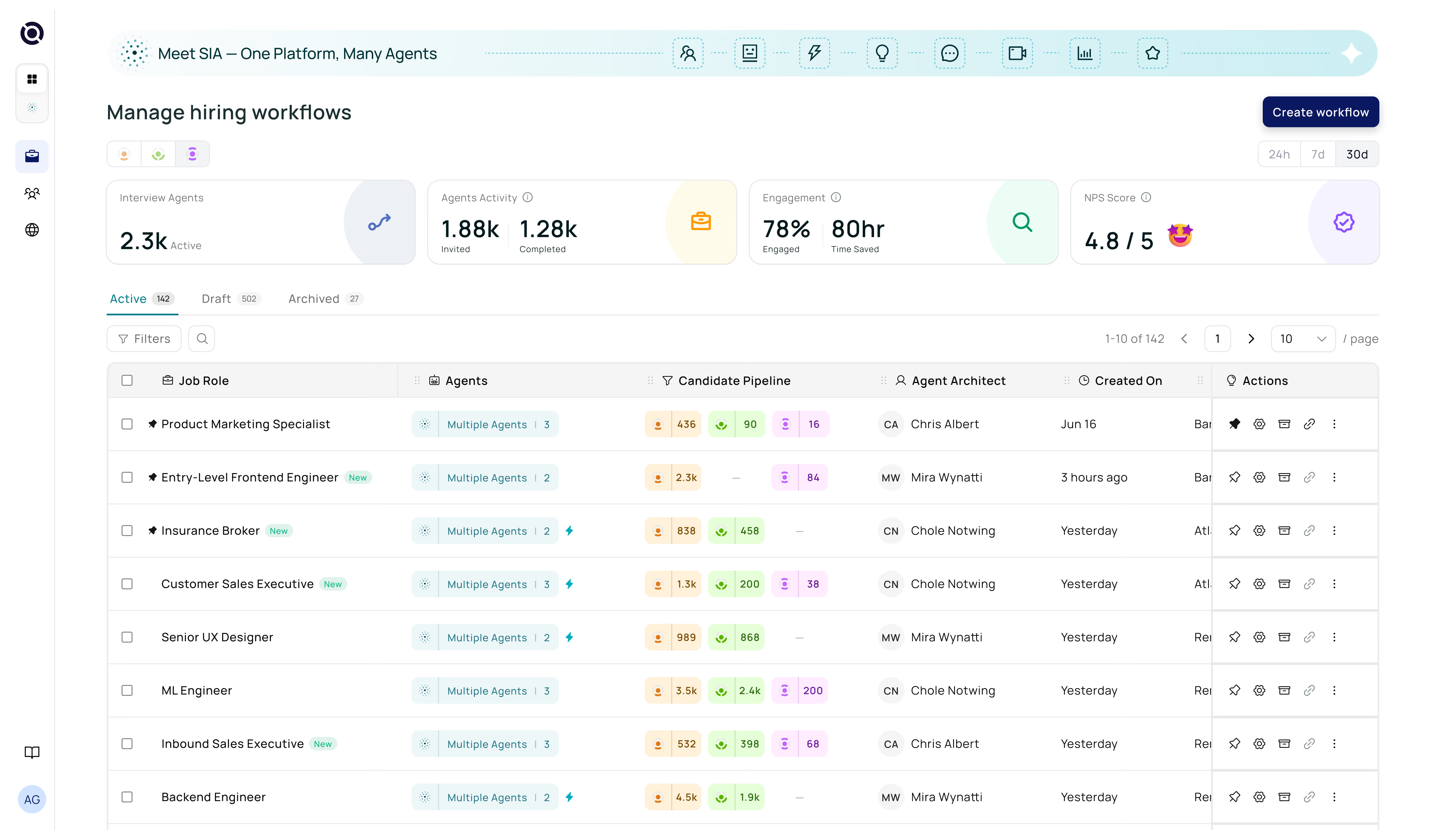
NPS score achieved by Senseloaf clients using AI Chat Agents—a result of instant engagement, consistent communication, and personalised next-step routing that reduces candidate drop-off significantly.
The SHRM data reinforces the broader picture: 89% of HR professionals at organisations using AI in recruitment report it saves time or increases efficiency. Among automation adopters, recruiters fill 64% more jobs and submit 33% more candidates per person—a productivity multiplier that compounds across high-volume hiring environments. The case for recruitment process automation is no longer theoretical—organisations that adopt it systematically outperform those that do not, on speed, quality, and candidate satisfaction simultaneously.
The Challenges: What Is Still Getting in the Way
The benefits are real—but so are the challenges. For organisations that have not yet deployed AI agents in recruitment successfully, several friction points consistently emerge.
Volume Without Consistency
Handling 800+ applicants a day without AI means inconsistent evaluation, missed candidates, and a candidate experience that deteriorates under volume pressure.
Unqualified Application Overload
Without smart filtering, recruiters spend hours on profiles that never match. Each poor-fit review is time away from top candidates who need faster responses.
High Funnel Drop-Off Rates
When communication lags or the process drags, strong candidates disengage and accept offers elsewhere. Drop-off is almost always a symptom of a speed problem, not a candidate preference problem.
The Human Touch Question
Only 31% of candidates are comfortable with AI making the hiring decision alone. That figure jumps to 75% when a human remains involved. Agentic AI must support human judgment—not replace it.
Governance and Bias Risk
AI trained on historical hiring data can inherit and amplify existing bias at scale. Without governance-first architecture, speed gains come with compliance exposure that compounds with every automated decision.
AI does not create bias from nowhere—it scales bias that already exists. A single biased evaluation criterion, applied to thousands of candidates per month, can produce discriminatory outcomes before any audit catches it. This is why Senseloaf’s approach to AI screening embeds governance at the architecture level—not as a policy overlay added after deployment.
The organisations seeing the strongest results from AI in their recruitment process share one characteristic: they deployed AI as an orchestration layer, not a replacement layer. Speed came from automation; quality came from human oversight remaining at the decision points that mattered.
“AI doesn’t create bias on its own—but it can scale existing bias faster than any human process ever could. Responsible AI is not about trusting recruiters to do the right thing. It’s about building systems that prevent the wrong thing from happening.”— Senseloaf AI, Responsible AI Framework, 2026
Real-World Case Study: How an RPO Firm Scaled Smarter
Let us bring this to life with a real example. A recruitment process outsourcing (RPO) firm operating across the United States and Canada faced a challenge that many talent acquisition teams recognise immediately.
The Situation
The firm was processing over 800 candidate applications per day. Recruiters were overwhelmed by unqualified applications. Candidates were disengaging because responses took too long. The process was not scalable—and the firm knew it was losing strong candidates to competitors with faster pipelines.
Speed and consistency at 800+ daily applications cannot be maintained manually. Every additional day in the process is a day a strong candidate is talking to another employer. The RPO firm needed recruitment automation that could scale without degrading the quality of evaluation or the candidate experience.
The Senseloaf Solution
The firm integrated the full Senseloaf AI platform with their existing ATS—not as a replacement, but as an intelligent orchestration layer across every stage of candidate qualification.
AI Resume Screening with Explainable Ranking
Candidate screening and ranking ran inside the ATS using Explainable AI—making it transparent to recruiters why a candidate ranked where they did. Every score was traceable to specific criteria, not a black-box output.
Conversational AI Pre-Screening
An AI assistant handled pre-screening conversations, responded to candidate FAQs, and routed qualified applicants directly to assessments—all without recruiter involvement at this stage. Conversational AI for hiring at this volume produces consistent, immediate candidate engagement that manual processes cannot replicate.
Dynamic Matching Across Multiple Signals
Rather than screening on keywords alone, Senseloaf’s dynamic matching assessed candidates across skills, experience depth, previous role relevance, and assessment performance—creating shortlists significantly more relevant than filter-based screening alone could produce.
The Results (April 2023–March 2024)
The outcome was not just faster hiring—it was a fundamentally more reliable pipeline. Fewer drop-offs. More relevant interviews. A process that could finally keep pace with 800+ daily applications without sacrificing evaluation quality or candidate experience. This is the compounding return that well-implemented top AI recruiter agents produce over a 12-month deployment period.
Before vs. After: The Hiring Pipeline Transformed
| Metric | Before Senseloaf | With Senseloaf |
|---|---|---|
| Daily application volume | Manual—overwhelmed at 800+/day | Fully automated, consistent at scale |
| Resume screening method | Keyword filtering, inconsistent | Explainable AI ranking inside ATS |
| Candidate pre-screening | Recruiter-led, delayed response | AI Chat Agent—instant, 24/7 |
| Candidate drop-off rate | High—slow process drove disengagement | Significantly reduced |
| Candidates moved to interview | Constrained by recruiter capacity | 4,147 in 12 months |
| Positions filled | Below target—process bottleneck | 924 in 12 months |
| Total candidates screened | Manually constrained sample | 103,020—entire pipeline covered |
Myths vs. Facts: AI in Recruitment
The conversation around AI agents in recruitment carries more misinformation than most enterprise technology topics. These are the misunderstandings that most commonly delay adoption—and what the evidence actually shows.
Myth: AI in recruitment means replacing human recruiters.
Fact: 75% of candidates accept AI involvement when a human remains part of the final decision. The strongest deployments use AI to handle volume-intensive tasks—freeing recruiters for relationship-building and complex judgment calls.
Myth: AI screening is a black box that cannot be explained.
Fact: Explainable AI (XAI) produces traceable, skill-based rationales for every decision. The RPO case above ran on fully explainable scoring—recruiters could see exactly why a candidate ranked where they did.
Myth: AI creates bias in hiring.
Fact: AI inherits and can scale existing bias if governance is not built in. With governance-first architecture—protected characteristics blocked by default, criteria validated before deployment—AI candidate screening is more consistent and auditable than manual review.
Myth: AI recruitment tools require replacing the existing ATS.
Fact: Senseloaf integrates directly into existing ATS infrastructure. All AI outputs sync back into the ATS as the system of record—no disruption to existing workflows, no data migration required.
Myth: Candidates hate AI-driven hiring processes.
Fact: SP Data Digital achieved a 4.6 out of 5 candidate NPS using Senseloaf AI Chat Agents—a score that reflects a consistently positive experience, not just tolerated automation.
Frequently Asked Questions
103,020 candidates screened, 924 positions filled, fewer drop-offs—that is what agentic AI recruitment delivers at scale. See what this looks like for your team—book a free demo.