.png)



Introduction
AI in talent acquisition has crossed a threshold. It no longer just assists recruiters — it acts. It screens resumes, schedules interviews, scores candidates, and in some organizations, manages the end-to-end hiring pipeline with minimal human involvement. This is the era of agentic AI: systems that perceive, decide, and execute — often autonomously. The question for TA leaders isn't whether this applies to you. It's whether your governance is keeping pace.
KPMG's framework for AI governance in the agentic era offers a practical starting point. Their TACO model — Taskers, Automators, Collaborators, Orchestrators — classifies AI agents by their level of autonomy and systemic reach. Applied to talent acquisition, it becomes a powerful lens for identifying where your governance gaps are hiding.
The KPMG TACO Framework in TA
Before diving into the five things, here's how the four TACO archetypes map to hiring — and why each demands a distinct governance approach.
You Need to Know What Kind of Agent You're Running
Governance starts with classification. Most TA functions have deployed AI tools without ever categorizing them by risk profile — and that's a problem, because a resume screener and a multi-system hiring platform require fundamentally different oversight models.
The KPMG TACO framework, detailed in their 2025 AI governance report, provides exactly this classification layer. The archetype determines the risk surface. The risk surface determines the governance model. If you can't name what's running in your stack, you can't govern it — and when something goes wrong, you can't explain it to a regulator either.
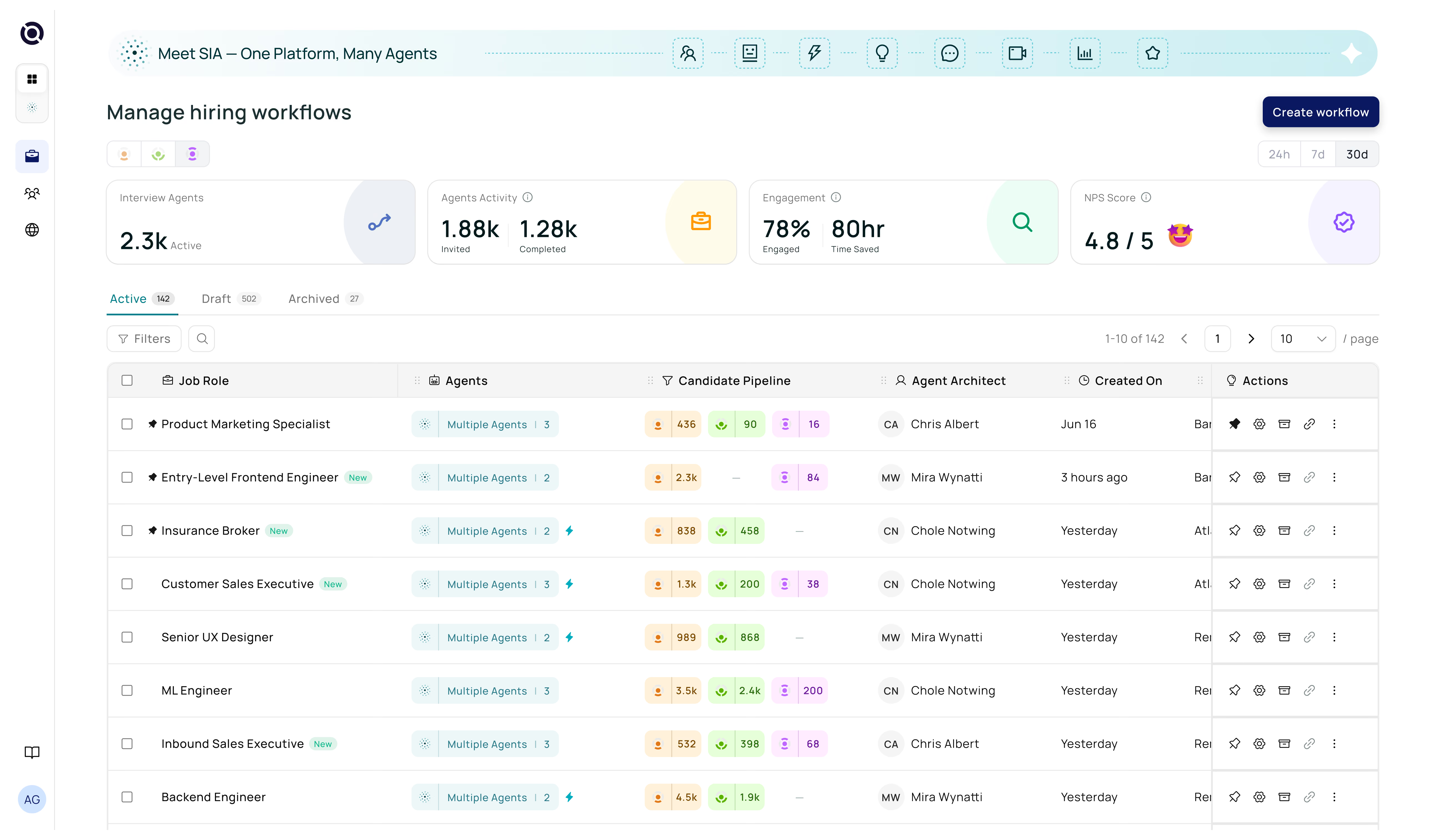
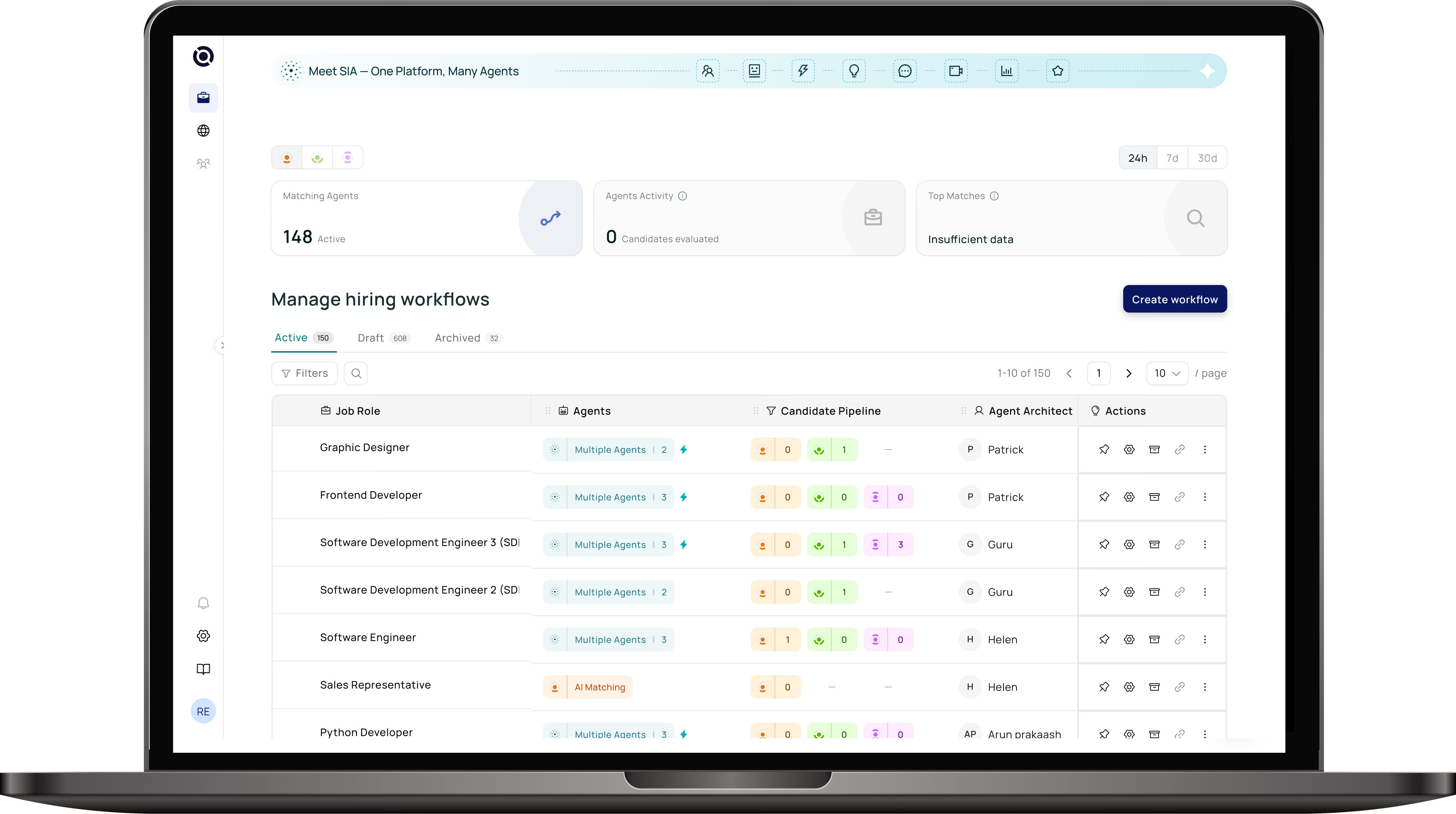
At Senseloaf, our Matching Agent is designed with classification-first principles — so TA teams always know what the AI is doing and where a human remains in control.
Audit every AI tool in your TA stack this quarter. Assign a TACO classification to each. If you can't classify it, you can't govern it.
Taskers Are Legally Exposed – Even When They Feel Simple
Resume screening agents are the most widely deployed form of AI in TA. They are also the most legally scrutinized. Because they operate at the top of the funnel — making or influencing pass/fail decisions on every applicant — their outputs carry significant regulatory weight.
The risk is threefold. First, bias encoded in training data: if historical hiring data reflects past discrimination, a model trained on that data will replicate it. Second, explainability failures: candidates rejected by AI-driven screeners are often entitled to a reason, and "the model ranked you lower" is insufficient under emerging law. Third, regulatory exposure: New York City's Local Law 144 requires bias audits for automated employment decision tools. Illinois' Artificial Intelligence Video Interview Act governs AI in interviews. The EU AI Act classifies hiring AI as high-risk by default. Track how these decisions affect your pipeline with the right hiring metrics.
Taskers feel low-stakes because they're narrow. That narrowness is deceptive — they touch every candidate, at the moment of highest legal sensitivity.
Require a third-party bias audit before deploying any Tasker. Define a human-review threshold for decisions involving protected-class attributes. Document model outputs for every rejection.
Automators Remove Speed Bumps – and Accountability
Fully automated hiring pipelines are the efficiency dream: a candidate enters at application, and the system handles screening, assessment, scheduling, and shortlisting — without a recruiter touching the process until the final stage. Some platforms are pushing this toward AI-managed offer generation.
The governance problem isn't the automation itself. It's the accountability vacuum it creates. When every step is AI-driven, it becomes nearly impossible to identify where a flawed decision originated — or who is responsible for it. Vendor contracts often further obscure this, with liability language that places risk back on the employer.
Automators also create feedback loop risk. A system trained on past successful hires will optimize toward candidates who resemble those hires — entrenching historical patterns, including historical biases, at scale. See how Senseloaf approaches responsible pipeline automation.
Define mandatory human intervention points in every automated pipeline. Contractually bind vendors to explainability standards and audit rights. Establish who legally owns each AI-generated decision before the pipeline goes live.
Collaborators Shape Human Judgment – Without Anyone Noticing
AI interview assistants — tools that score candidate responses, flag engagement levels, or surface recommended follow-up questions during live interviews — are positioned as decision support, not decision makers. That framing understates their influence.
Research on automation bias consistently shows that humans anchor heavily to algorithmic recommendations, even when they believe they're exercising independent judgment. An interviewer who sees a "cultural alignment score" before the debrief is not making an uninfluenced assessment. Because a human is nominally in the loop, organizations often assume governance isn't required. But the human may be making decisions that are effectively downstream of the AI's framing.
Behavioral and emotional AI scoring in interviews deserves particular scrutiny. Many tools in this space lack peer-reviewed validity evidence, and several have faced regulatory challenge for discriminatory impact. Learn more about how automation shapes hiring decisions in our guide to how AI matching automation works.
Audit what signals your interview AI surfaces, to whom, and when. Train interviewers on automation bias. Prohibit behavioral or emotional scoring without documented scientific validity.
Orchestrators Are Where Governance Becomes Existential
Orchestrators are the most powerful and least governed agents in enterprise TA. These are multi-system platforms — typically modern ATS and talent intelligence suites — that connect sourcing, screening, assessment, scheduling, and analytics into a unified, AI-coordinated workflow.
As KPMG's framework highlights, Orchestrators don't just execute tasks — they coordinate other agents. That means risk compounds. A bias in a Tasker feeding into an Orchestrator doesn't stay contained — it propagates across the entire pipeline. A data governance failure in one connected system becomes a failure everywhere.
Orchestrators also create vendor accountability complexity at a new scale. When multiple AI vendors are operating through a single platform, attributing a flawed outcome to a specific decision point — and a specific responsible party — becomes legally and operationally difficult. This is the layer where governance can't be retrofitted. Explore how Senseloaf's platform is built for Orchestrator-level accountability.
Map your agent ecosystem before you expand it. Demand full data lineage documentation from Orchestrator vendors. Appoint a named TA AI Risk Owner — with authority to pause any process that breaches governance standards — before your next major platform deployment.
The Bottom Line for TA Leaders
Agentic AI is not a future state. It is the current operating environment for most mid-to-large TA functions. The leaders who navigate this well won't be those who deploy the most — they'll be those who govern the best. If you're still evaluating whether agentic AI makes financial sense, see how it impacts cost-per-hire and candidate experience.
The KPMG TACO framework, explored in depth in their AI governance for the agentic era report, offers TA leaders a starting vocabulary for this work. Classification comes first. Then audit. Then accountability. For a practical implementation roadmap, read our guide to agentic AI recruitment for HR leaders.
Governance is not the brake on AI adoption. It's what makes adoption defensible — legally, ethically, and strategically. Learn how Senseloaf helps TA teams do both at senseloaf.ai.
Framework credit: KPMG — AI Governance for the Agentic AI Era (2025)
Regulatory references: EEOC Guidelines · NYC Local Law 144 · Illinois AI Video Interview Act · EU AI Act